Ointment Manufacturing Plant — Leading Manufacturer, Supplier & Exporter in India
Bipin Pharma Equipment is a trusted manufacturer, supplier, and exporter of Ointment Manufacturing Plants in India. Engineered specifically for high-viscosity semi-solid products, our ointment plants handle the thick, dense masses that ordinary mixers cannot — delivering uniform, air-free ointments, gels, and pastes to pharmaceutical and cosmetic manufacturers worldwide.
While our Cream & Lotion Manufacturing System is optimised for pourable emulsions, the Ointment Manufacturing Plant is built around vacuum mixing with anchor and scraper agitation for semi-solid consistency. See also our individual Cream and Lotion Equipments.
▶ Watch the Ointment Plant in Action
What is an Ointment Manufacturing Plant?
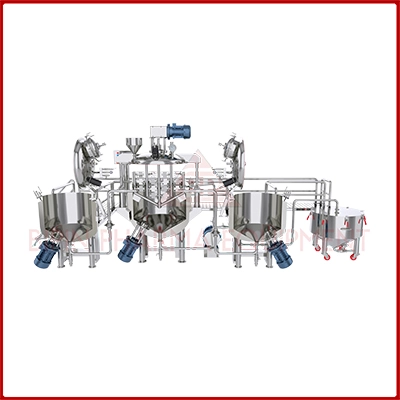
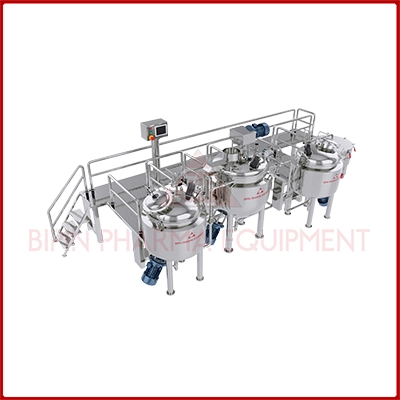
An Ointment Manufacturing Plant is a complete, vacuum-based manufacturing system designed to produce ointments, gels, pastes, and other semi-solid pharmaceutical and cosmetic preparations. The plant integrates phase-preparation vessels, a main vacuum mixing vessel, high-shear homogenization, and scraper agitation into a single GMP-compliant line.
The defining feature of an ointment plant is its ability to process high-viscosity products. A robust anchor agitator fitted with PTFE scraper blades continuously moves the thick mass and keeps it sweeping the heated vessel wall, while vacuum draws out entrapped air for a smooth, dense, homogeneous finished product.
Key Features of Ointment Manufacturing Plant
Vacuum Mixing
Vacuum removes entrapped air from dense, viscous ointments — preventing oxidation and producing a smooth, bubble-free product.
Anchor & Scraper Agitation
Heavy-duty anchor agitator with PTFE scraper blades keeps high-viscosity mass moving and sweeping the vessel wall for even heating.
High-Shear Homogenizer
Disperses actives and breaks down agglomerates for uniform distribution throughout the ointment base.
Jacketed Heating & Cooling
Steam/thermic-fluid heating and chilled-water cooling for precise temperature control of the base and actives.
GMP Hygienic Design
Pharmaceutical-grade SS 316L contact parts, mirror polished, with CIP/SIP options for contamination-free production.
Integrated Transfer & Filling
Product transfer pumps and optional tube/jar filling integration complete the line from raw material to packed product.
Material of Construction
The Ointment Manufacturing Plant is available in MS, SS304, SS316, SS316L, and Hastelloy. Various kinds of fluoropolymer coating on contact surfaces — including Halar, PP, ETFE, PFA, and PVDF — are available for corrosion-sensitive applications. For pharmaceutical GMP applications, SS 316L mirror-polished contact parts are standard.
How an Ointment Manufacturing Plant Works
Phase Preparation: The oil/wax (base) phase and the aqueous/active phase are separately heated and prepared in dedicated jacketed vessels.
Vacuum Transfer: Phases are drawn into the main vacuum mixing vessel under vacuum, avoiding air entrapment from the start.
Mixing & Homogenization: The anchor agitator with scraper keeps the viscous mass moving while the high-shear homogenizer disperses actives uniformly.
Vacuum De-aeration: Continued vacuum pulls air out of the dense ointment, producing a smooth, void-free product.
Cooling & Discharge: The ointment is cooled under gentle scraper agitation and transferred to storage or directly to the tube/jar filling line.
Petroleum-Based Products: Petroleum jelly and jelly-based formulations.
Cosmetic Semi-Solids: Thick cosmetic creams, hair waxes, and styling pastes.
Veterinary Topicals: Medicated ointments and pastes for veterinary use.
Why Choose Bipin Pharma Equipment for Ointment Plants?
Specialist Expertise: Decades of experience building semi-solid and emulsion plants since 1995.
Customization: Tailored to your viscosity, batch size, and automation level.
Global Reputation: Trusted by clients across India and 25+ countries internationally.
Compliance: Built to GMP and international quality standards.
End-to-End Support: From installation and commissioning to maintenance and spares.
Frequently Asked Questions
What is an Ointment Manufacturing Plant?
An Ointment Manufacturing Plant is a complete vacuum-based system for producing ointments, gels, pastes, and other semi-solid pharmaceutical and cosmetic products. It integrates a wax/oil phase vessel, a water phase vessel, a main vacuum mixing vessel with anchor agitator and high-shear homogenizer plus scraper, and transfer arrangements — designed to handle high-viscosity products that ordinary mixers cannot.
How is ointment manufacturing different from cream and lotion manufacturing?
Ointment manufacturing handles much higher-viscosity, often anhydrous or low-water products, so it relies on robust anchor agitators with scraper blades to keep the thick mass moving against the vessel wall, plus vacuum to remove air from the dense product. Cream and lotion manufacturing handles lower-viscosity emulsions where high-shear homogenization dominates. Bipin Pharma builds both, with the ointment plant engineered for semi-solid consistency.
What is the material of construction of Bipin Pharma Ointment Manufacturing Plant?
Bipin Pharma Ointment Manufacturing Plants are available in MS, SS304, SS316, SS316L, and Hastelloy, with pharmaceutical-grade SS 316L as standard for product contact parts. Various fluoropolymer coatings on contact surfaces are also available including Halar, PP, ETFE, PFA, and PVDF. Contact surfaces are mirror polished for GMP compliance and easy cleaning.
What products can be made in an Ointment Manufacturing Plant?
An Ointment Manufacturing Plant can produce medicated ointments, topical gels, pastes, balms, petroleum-jelly based products, antiseptic and antifungal creams, and other semi-solid formulations. With the vacuum mixing and scraper agitation it handles thick, viscous masses while ensuring uniform dispersion of the active ingredient and a smooth, air-free finished product.
Looking for an Ointment Manufacturing Plant? Get a Free Quote
Bipin Pharma Equipment manufactures GMP-compliant Ointment Manufacturing Plants — SS 316L, vacuum mixing with anchor and scraper agitation for ointments, gels and pastes, exported to 25+ countries. Contact us for a tailored proposal.