Cream and lotion manufacturing is a sophisticated pharmaceutical and cosmetic process requiring precise temperature control, vacuum homogenisation, and careful emulsification to produce stable, uniform products. Creams, lotions, gels, and ointments form the backbone of topical pharmaceutical formulations — from medicated creams to cosmetic moisturisers. Manufacturing these to GMP standards requires a specialised equipment line.
As a trusted cream and lotion manufacturing plant supplier in India, Bipin Pharma Equipment designs and manufactures complete topical manufacturing systems for pharmaceutical and cosmetic companies across India and 25+ countries.
| Dosage Form | Description | Examples |
|---|---|---|
| Cream (O/W) | Oil-in-water emulsion — water-based, non-greasy | Betamethasone cream, moisturising cream |
| Cream (W/O) | Water-in-oil emulsion — oil-based, occlusive | Cold cream, barrier cream |
| Lotion | Low-viscosity O/W emulsion — pourable | Calamine lotion, hand lotion |
| Ointment | Anhydrous or near-anhydrous semi-solid | Zinc ointment, petroleum-based ointments |
| Gel | Transparent or translucent semi-solid | Diclofenac gel, hair gel |
| Paste | High-solids content semi-solid | Zinc paste, dental paste |
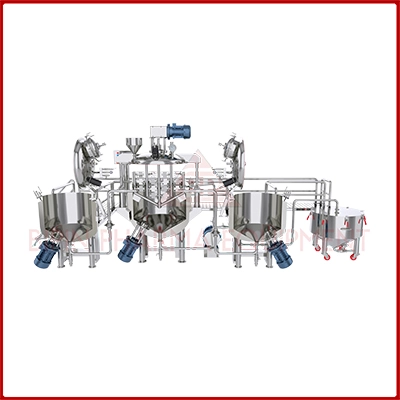
Complete cream and lotion manufacturing plant with vacuum emulsifier, homogeniser, water and oil phase vessels. GMP-compliant, SS 316.
View Cream & Lotion System →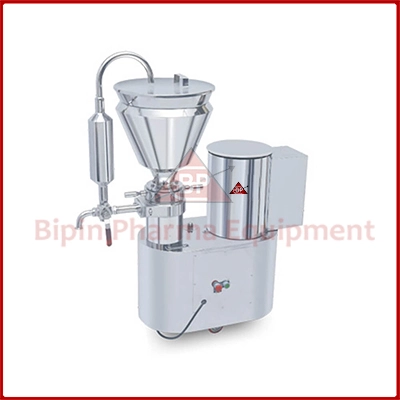
Used for size reduction and homogenisation of cream/ointment formulations. Available in 3HP and 5HP, water-jacketed models for temperature control.
View Colloid Mill →The water phase (purified water, humectants like glycerine or propylene glycol, water-soluble excipients and preservatives) is charged into the Water Phase Vessel (SS 316, steam-jacketed with anchor agitator) and heated to 70–80°C with stirring to ensure full dissolution.
The oil phase (emulsifying waxes, stearic acid, cetyl alcohol, mineral oil, silicones, oil-soluble preservatives, and lipophilic APIs) is charged into the Oil Phase Vessel (SS 316, steam-jacketed) and heated to 70–80°C to melt and homogenise all components.
Both phases (water and oil) are transferred at the same temperature (70–80°C) into the main Manufacturing Vessel. The vessel is equipped with a vacuum system, a slow-speed anchor agitator (for bulk movement), and a high-speed homogeniser (rotor-stator type). Under vacuum and with both agitators running, the oil phase is dispersed into the water phase (or vice versa for W/O), forming a primary emulsion.
The high-speed homogeniser reduces droplet size to 1–5 µm, creating a stable, uniform emulsion. Vacuum prevents air entrapment during mixing, which would otherwise create foam, affect product appearance, and compromise stability.
The homogeniser is stopped, and the product is cooled under slow agitation using the vessel jacket (chilled water). Heat-sensitive APIs, fragrances, and volatile active ingredients are added during the cooling phase (typically at 40–45°C) to prevent degradation.
In-process QC testing: pH, viscosity, appearance, specific gravity, and API assay. The finished product is discharged through the bottom valve into tubes, jars, or bottles by cream/lotion filling machines.
| Equipment | Function |
|---|---|
| Water Phase Vessel (SS 316, jacketed) | Prepare and heat the aqueous phase |
| Oil Phase Vessel (SS 316, jacketed) | Melt and prepare the oil phase |
| Main Manufacturing Vessel (Vacuum Emulsifier) | Combine phases, emulsify, homogenise under vacuum |
| Colloid Mill / High Shear Homogeniser | Size reduction and uniformity for ointments and thick gels |
| Storage Vessel | Hold finished product before filling |
| Cream / Tube / Jar Filling Machine | Fill into tubes, jars, and bottles |
Cream and lotion manufacturing requires precise emulsification under vacuum with controlled temperature — the vacuum emulsifier with homogeniser is the central piece of equipment. Bipin Pharma Equipment designs and manufactures complete cream and lotion manufacturing systems — from individual phase vessels to complete turnkey lines. Contact us with your batch size and product type for a complete system quote.
Our technical team can recommend the right equipment — free consultation.
Send Enquiry Call: +91 88791 92449Bipin Pharma Equipment supplies complete cream and lotion manufacturing lines — vacuum emulsifier, water/oil phase vessels, colloid mill. GMP-compliant, 25+ countries served. Contact us today.
Request a Free Quote View Cream & Lotion System