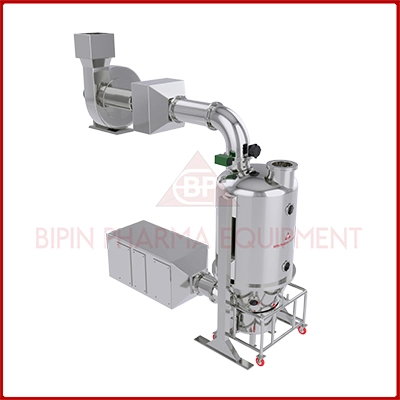
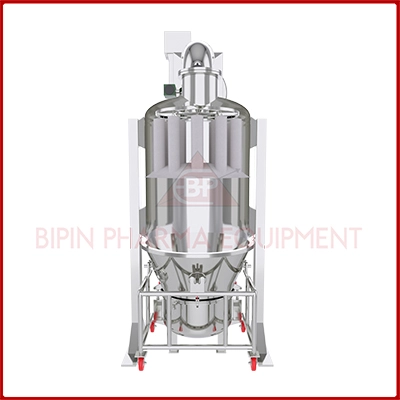
Granulation System
Granulation is one of the most critical processes in pharmaceutical solid dosage manufacturing. Whether you are producing tablets, capsules, or granules for direct filling, the granulation process determines the quality, flowability, compressibility, and uniformity of your final product. In this comprehensive guide, we explore the pharmaceutical granulation process end-to-end — covering the types of granulation, key equipment involved, process parameters, and how to select the right machinery for your production needs.
As a trusted pharmaceutical equipment manufacturer and exporter in India, we manufacture the complete range of granulation equipment to GMP standards — from Rapid Mixer Granulators to Fluid Bed Dryers and beyond.
What is Granulation in Pharma?
Granulation is the process of forming particles or granules from fine powder particles. It creates larger, free-flowing aggregates that improve handling, compression, and dosage uniformity. Granulation is essential because raw pharmaceutical powders are often too fine, too cohesive, or too segregation-prone to be directly compressed into tablets.
The granulation process binds fine powder particles together using a liquid binder or by compaction to produce granules of the desired size, shape, and density. These granules then undergo drying, milling, and blending before tablet compression or capsule filling.
Why is Granulation Important?
Granulation offers the following benefits in pharmaceutical manufacturing:
- Improves powder flowability for consistent die filling during tablet compression
- Increases bulk density of fine powders
- Reduces dust generation and cross-contamination risk
- Improves content uniformity — especially for low-dose active ingredients
- Enhances compressibility and tablet hardness
- Prevents segregation of multi-component blends
- Controls the dissolution rate of the final dosage form
Types of Granulation Processes
1. Wet Granulation
Wet granulation is the most widely used granulation method in the pharmaceutical industry. In this process, a liquid binder — typically water, ethanol, or an aqueous binder solution — is added to the powder blend to form granules. The wet mass is then dried to remove the solvent and achieve the desired moisture content.
The primary equipment used for wet granulation is the Rapid Mixer Granulator (RMG), also known as a High Shear Mixer Granulator. The RMG combines mixing, wet massing, and granulation in a single closed bowl, offering high efficiency and GMP compliance. After granulation, the wet granules are transferred to a Fluid Bed Dryer (FBD) for drying.
2. Dry Granulation
Dry granulation does not use any liquid binder. Instead, the powder blend is compacted under high pressure using a roller compactor or a slugging machine. The resulting slugs or ribbons are then broken down into granules using a mill.
Dry granulation is preferred for moisture-sensitive or heat-sensitive APIs. A Multi Mill is commonly used after roller compaction to achieve the desired granule size distribution.
3. Fluid Bed Granulation
In fluid bed granulation, the powder is fluidized by a stream of air in a Fluid Bed Dryer equipped with a spray nozzle. The binder solution is sprayed onto the fluidized powder bed, forming granules in situ. Fluid bed granulation combines granulation and drying in a single unit operation, reducing processing time and improving granule porosity.
Step-by-Step Wet Granulation Process
The wet granulation process using a Rapid Mixer Granulator follows these steps:
| Step | Process Stage | Equipment Used |
|---|---|---|
| 1 | Dry Mixing of API + Excipients | Rapid Mixer Granulator |
| 2 | Binder Addition & Wet Massing | Rapid Mixer Granulator |
| 3 | Wet Granule Sizing (optional) | Multi Mill / Vibro Sifter |
| 4 | Drying of Wet Granules | Fluid Bed Dryer / Tray Dryer |
| 5 | Dry Granule Sizing / Milling | Multi Mill |
| 6 | Sieving / Screening | Vibro Sifter |
| 7 | Lubrication & Final Blending | Double Cone Blender / Octagonal Blender |
| 8 | Transfer to Compression | IPC Bin |
Key Equipment in the Granulation Line
Rapid Mixer Granulator
The Rapid Mixer Granulator (RMG) is the heart of the wet granulation process. It consists of a stainless steel bowl, a bottom-driven main impeller, and a side-mounted chopper. The impeller creates a fluidized mixing zone while the chopper breaks down wet lumps to produce uniform granules. Key features include variable impeller and chopper speeds, stainless steel SS316L contact parts, and CIP (Clean-in-Place) compatibility.
Fluid Bed Dryer
After granulation, wet granules contain residual moisture that must be removed. The Fluid Bed Dryer (FBD) is the most efficient dryer for pharmaceutical granules. Heated air is passed upward through a perforated plate, fluidizing the granules and achieving uniform drying with minimal product degradation. FBDs offer shorter drying times compared to tray dryers, making them the preferred choice in modern granulation suites.
Vibro Sifter
The Vibro Sifter separates oversized and undersized granule fractions after milling. It uses a vibrating motor to drive a circular sieving action through multiple mesh screens. Vibro sifters ensure the granule size distribution is within specification before the blending step.
Double Cone Blender & Octagonal Blender
Final blending of granules with lubricants (e.g., magnesium stearate) is carried out in a Double Cone Blender or Octagonal Blender . These tumble blenders offer gentle, low-shear blending that preserves granule structure while ensuring uniform distribution of lubricants and glidants.
IPC Bin
The IPC Bin (In-Process Container Bin) is used to transport granules between process stages in a closed, contamination-free manner. IPC Bins are designed for smooth material transfer from blenders to tablet presses, ensuring GMP compliance throughout the granulation-to-compression workflow.
Granulation Process Parameters to Monitor
| Parameter | Relevance | Equipment |
|---|---|---|
| Impeller Speed (RMG) | Granule size & density | Rapid Mixer Granulator |
| Chopper Speed (RMG) | Lump breaking | Rapid Mixer Granulator |
| Binder Addition Rate | Granule uniformity | Rapid Mixer Granulator |
| Inlet Air Temperature | Drying efficiency | Fluid Bed Dryer |
| Product Temperature | API stability | Fluid Bed Dryer |
| Loss on Drying (LOD) | Final moisture content | Fluid Bed Dryer |
| Screen Size (Multi Mill) | Granule size distribution | Multi Mill |
| Blend Time | Lubrication uniformity | Double Cone / Octagonal Blender |
Wet Granulation vs Dry Granulation — Quick Comparison
| Feature | Wet Granulation | Dry Granulation |
|---|---|---|
| Binder used | Yes (liquid) | No |
| Suitable for | Most APIs | Moisture/heat sensitive APIs |
| Key equipment | RMG + FBD | Roller Compactor + Multi Mill |
| Granule porosity | Higher | Lower |
| Dissolution | Generally faster | Depends on compaction force |
| Process steps | More | Fewer |
| Cost | Moderate | Lower (no drying step) |
GMP Considerations in Granulation
All granulation equipment used in pharmaceutical manufacturing must comply with GMP (Good Manufacturing Practice) requirements as per US FDA 21 CFR Part 211, WHO GMP, and Schedule M guidelines. Key GMP requirements include:
- All product-contact parts must be SS316L stainless steel
- Equipment must be designed for easy cleaning and validation (CIP/SIP where required)
- Enclosed material handling to prevent cross-contamination
- Calibrated instrumentation for process parameter monitoring
- Equipment must be compatible with dust containment systems
- Documentation of DQ, IQ, OQ, and PQ validation protocols
Frequently Asked Questions (FAQ)
What is the most common granulation method in pharma?
Wet granulation using a High Shear Rapid Mixer Granulator followed by Fluid Bed Drying is the most widely used granulation method in the pharmaceutical industry due to its ability to produce uniform, compressible granules suitable for tablet compression.
What equipment is needed for a complete granulation line?
A complete granulation line includes: Rapid Mixer Granulator , Fluid Bed Dryer , Multi Mill , Vibro Sifter , Double Cone Blender or Octagonal Blender, and an IPC Bin for material transfer.
What is Loss on Drying (LOD) in granulation?
Loss on Drying (LOD) is the percentage loss in weight of a granule sample after drying under specified conditions. It represents the residual moisture content in the granules. Typical LOD targets in pharmaceutical granulation range from 1% to 3%, depending on the formulation.
Why is Fluid Bed Dryer preferred over Tray Dryer for granules?
Fluid Bed Dryers offer significantly shorter drying times, more uniform heat distribution, and lower risk of granule over-drying compared to conventional Tray Dryers. FBDs are the industry standard for drying pharmaceutical granules produced by wet granulation.
Can granulation be done without a Rapid Mixer Granulator?
Yes. Fluid bed granulation can be performed entirely within a Fluid Bed Dryer equipped with spray nozzles, without a separate RMG. However, for high-shear granulation of cohesive or dense formulations, the Rapid Mixer Granulator remains the preferred choice.
Conclusion
The pharmaceutical granulation process is a multi-step, equipment-intensive operation that directly impacts product quality, yield, and regulatory compliance. Selecting the right granulation equipment — from the Rapid Mixer Granulator to the Fluid Bed Dryer , Multi Mill , Vibro Sifter , and Blenders — is essential for achieving consistent, validated, and GMP-compliant manufacturing outcomes.
We are a leading manufacturer, supplier, and exporter of pharmaceutical granulation equipment in India. To enquire about our granulation equipment range, contact us today or submit an enquiry .