Complete List of Pharma Equipment Required in a Tablet Manufacturing Plant
Tablets are the most widely manufactured pharmaceutical dosage form in the world — accounting for more than 70% of all pharmaceutical products globally. Setting up a GMP-compliant tablet manufacturing plant requires a carefully selected suite of equipment covering every stage of the manufacturing process, from raw material dispensing through granulation, drying, blending, compression, coating, and packaging. This guide provides the complete, authoritative equipment list for a pharmaceutical tablet manufacturing plant — with technical descriptions, GMP requirements, and internal links to all relevant equipment pages.
Whether you are establishing a new tablet manufacturing facility, upgrading an existing plant, or planning capacity expansion, this comprehensive equipment reference will help you identify and specify every piece of equipment required for GMP-compliant tablet production.
We are a leading manufacturer, supplier, and exporter of pharmaceutical granulation, blending, drying, and coating equipment for tablet manufacturers in India and worldwide.
Tablet Manufacturing Process: Overview of Key Stages
Before listing equipment, it is important to understand the tablet manufacturing process flow. All tablet manufacturing — whether by wet granulation, dry granulation, or direct compression — follows this general sequence of unit operations:
| Stage | Unit Operation | Purpose |
|---|---|---|
| 1 | Raw material dispensing and weighing | Accurate dispensing of API and excipients per batch formula |
| 2 | Sifting / screening | De-lumping and particle size classification of raw materials |
| 3 | Granulation (wet or dry) | Agglomeration of fine powders into granules for improved flow and compressibility |
| 4 | Drying (for wet granulation) | Removal of granulation solvent to target LOD specification |
| 5 | Sizing / milling | Breaking oversized granules to target particle size distribution |
| 6 | Blending / mixing | Uniform mixing of dried granules with lubricants and extragranular excipients |
| 7 | Tablet compression | Compacting the blended granule/powder into tablet form |
| 8 | Tablet coating (if required) | Applying film coat or sugar coat for taste masking, stability, or modified release |
| 9 | In-process quality control | Testing hardness, friability, disintegration, weight, thickness at each stage |
| 10 | Packaging | Blister packing or bottle packing; labelling; carton packing |
Complete Equipment List for a Tablet Manufacturing Plant
Stage 1: Dispensing and Weighing
Accurate dispensing of active pharmaceutical ingredients (APIs) and excipients is the first and foundational step. Dispensing errors at this stage propagate through the entire batch. GMP-compliant dispensing requires a dedicated dispensing booth with negative pressure (to contain API dust), calibrated weighing balances, and a dispensing record system.
Equipment Required for Dispensing
- Negative pressure dispensing booth (SS304/316L, HEPA-filtered, magnehelic pressure gauge)
- Analytical balance (for small quantities, 0–120 g range)
- Precision balance (for larger quantities, 0–60 kg range)
- Platform weighing scale (for bulk excipients, 0–300 kg range)
- Stainless steel scoops, spatulas, and dispensing containers (SS316L)
- Polybags, double-bagged containers for dispensed materials
- Bar code or RFID label printer for dispensing labels
Stage 2: Sifting and Screening
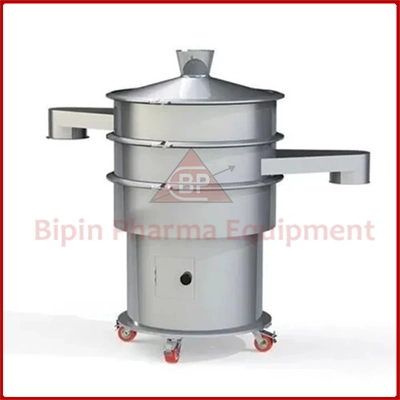
Before granulation or direct compression, all raw material powders must be sifted to break lumps, classify particles, and remove oversize particles or foreign matter. The Vibro Sifter is the standard equipment for this operation in tablet manufacturing.
| Equipment | Function | Key Specification |
|---|---|---|
| Vibro Sifter | Sifts and screens raw material powders; removes lumps and oversize particles; classifies by mesh size | SS316L contact parts; GMP design; mesh sizes 20–200 mesh; vibro motor drive |
| Inline sifter (optional) | Continuous inline sifting of powders during transfer to granulator or blender | Butterfly valve connection; SS316L; pneumatic operation |
Stage 3: Granulation — Wet Granulation Equipment
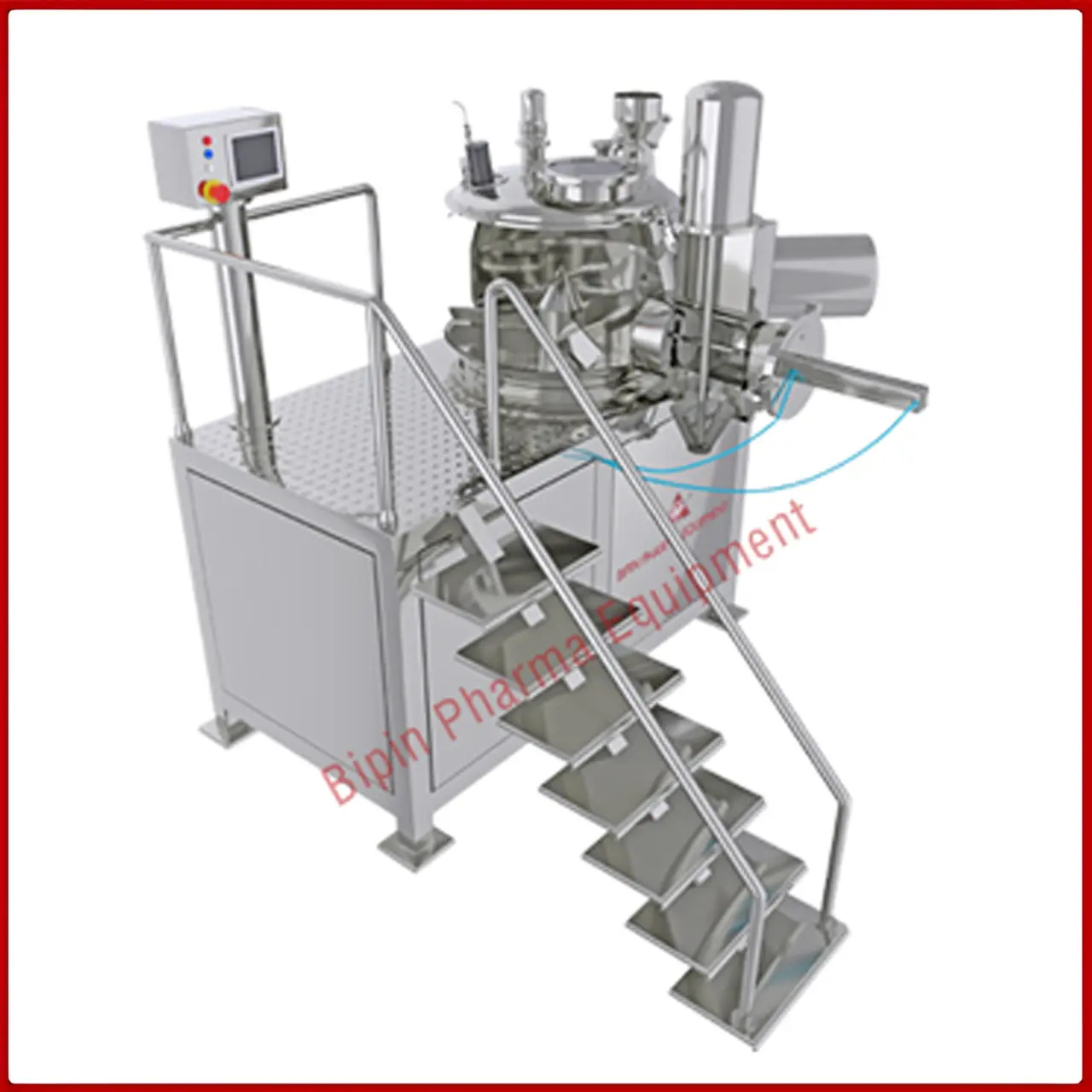
Wet granulation is the most widely used granulation method in tablet manufacturing. It produces dense, free-flowing granules with excellent compressibility by adding a binder solution to the dry powder blend and agglomerating the moistened mass. The two most important pieces of equipment for wet granulation are the Rapid Mixer Granulator (RMG) and the Paste Kettle.
| Equipment | Function | Key Specification |
|---|---|---|
| Rapid Mixer Granulator (RMG) | Dry mixing of API and excipients followed by wet granulation with binder solution; single vessel combines mixing and granulation | SS316L bowl; high-speed impeller + chopper; variable speed; bowl capacity 10–600 L; GMP design |
| Paste Kettle | Prepares binder paste (starch paste, HPMC solution, PVP solution) under heat and agitation for addition to RMG | SS316L; jacketed; tilting mechanism; anchor agitator; 25–500 L capacity |
| Binder solution spraying system | Controlled addition of binder solution to granulator at validated spray rate | Peristaltic pump; spray nozzle; SS316L pipework |
Stage 3 (Alternative): Dry Granulation Equipment
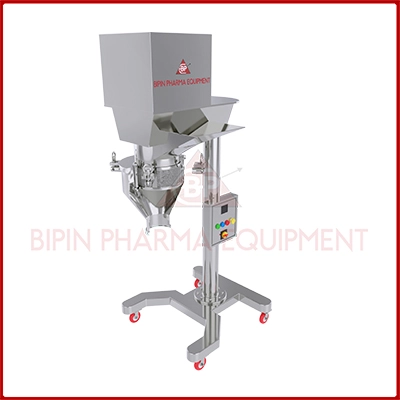
Dry granulation is used when the API or formulation is moisture-sensitive or heat-labile. It achieves granule formation without any liquid addition, using either roller compaction (forming ribbons that are then milled) or slugging (compressing into large slugs that are then milled). The Multi Mill is essential for both dry granulation sizing and wet granule sizing after drying.
| Equipment | Function in Dry Granulation | Key Specification |
|---|---|---|
| Roller Compactor | Compacts dry powder blend between two counter-rotating rollers to form dense ribbons; ribbons are then milled to granule size | SS316L contact parts; variable roll gap; hydraulic pressure control; ribbon milling integrated |
| Multi Mill | Milling / sizing of dry compacted ribbons or slugs to target granule size distribution | SS316L; variable speed rotor; interchangeable screens; GMP design; 20 mesh to 1 mm screens |
| Vibro Sifter | Classifies milled granules; removes fines (below mesh) and overs (above mesh) | SS316L; GMP design; 20–60 mesh screens for granule sizing |
Stage 4: Drying of Wet Granules
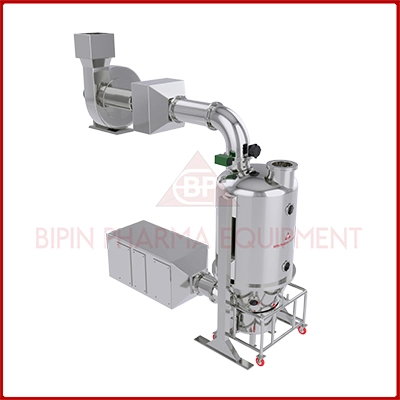
After wet granulation, the moist granule mass must be dried to a validated Loss on Drying (LOD) specification — typically 1–3% moisture content for most tablet formulations. Three types of dryers are used in tablet manufacturing, each with specific advantages:
| Equipment | Drying Method | Best For | Key Specification |
|---|---|---|---|
| Fluid Bed Dryer (FBD) | Hot air fluidisation; rapid, uniform drying; granules suspended and dried in hot air stream | High-volume production; fast cycle times; moisture-stable granules | SS316L bowl; HEPA inlet filter; explosion-proof (ATEX) motor; 10–600 kg batch; GMP design |
| Tray Dryer | Hot air circulation over granules spread on trays; slower, static drying | Small batches; heat-stable granules; pilot scale | SS316L trays; multi-zone temperature control; 12–192 trays; GMP design |
| Vacuum Tray Dryer (VTD) | Low-temperature drying under vacuum; gentle, slow drying | Heat-sensitive APIs; hygroscopic materials; moisture-sensitive formulations | SS316L trays; jacket heating; vacuum to 10 mbar; 12–192 tray capacity; GMP design |
Stage 5: Granule Sizing and Milling After Drying
Dried granules often contain lumps and oversized agglomerates that formed during drying. These must be broken down to the target granule size distribution before blending. The Multi Mill is the standard equipment for post-drying granule sizing in tablet manufacturing.
| Equipment | Function | Key Specification |
|---|---|---|
| Multi Mill | Breaks dried granule lumps to target particle size; controls granule size distribution for uniform blending and tablet compression | SS316L contact parts; rotor with interchangeable blades; screen sizes 0.5–5 mm; variable speed; GMP design |
| Vibro Sifter | Screens sized granules; separates fines and overs; collects in-specification granule fraction | SS316L; 20–60 mesh screens; vibro motor; GMP contact parts |
| Colloid Mill | Fine milling of hard agglomerates; particle size reduction to sub-100 µm range for special formulations | SS316L rotor-stator; variable gap; high speed; GMP design |
Stage 6: Blending and Mixing
After sizing, the dried, sized granules must be uniformly blended with extragranular excipients — particularly lubricants (magnesium stearate), glidants (colloidal silicon dioxide), and disintegrants. This final blending step is critical for tablet content uniformity. Two types of blenders are used depending on batch size and formulation requirements:
| Equipment | Blending Mechanism | Best For | Key Specification |
|---|---|---|---|
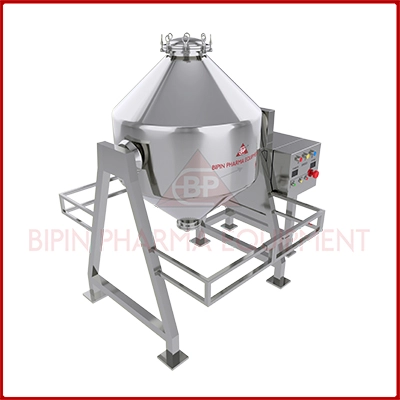
| Double Cone Blender | Tumbling action in double-cone vessel; gentle, low-shear mixing by gravity tumbling | Free-flowing granules; lubricant blending; dry powder blending; fragile granules | SS316L contact parts; variable speed (3–12 RPM); 50–5,000 L capacity; GMP design |
| Octagonal Blender | Tumbling action in octagonal vessel; more aggressive mixing than double cone due to octagonal baffling | Difficult-to-blend formulations; cohesive powders; where double cone is insufficient | SS316L; variable speed; 50–5,000 L capacity; intensifier bar option; GMP design |
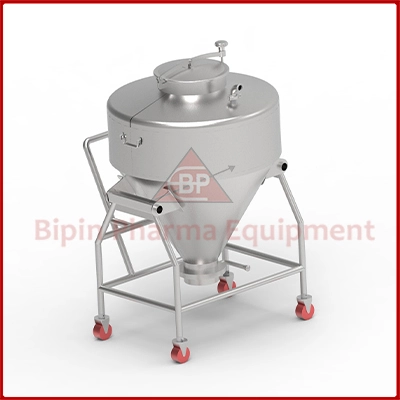
| IPC Bin | Intermediate Process Container — holds and transports blended granules between blender and tablet press; can be bin-blended directly on a bin blender | Closed transfer of blended granules; reduces contamination and segregation risk; GMP material handling | SS316L; 100–1,000 L capacity; Tri-Clamp fittings; GMP design; cleanable |
Stage 7: Tablet Compression
Tablet compression is performed by a rotary tablet press (not manufactured by Bipin Pharma Equipment, but a critical component of any tablet plant). The blended granules from the IPC Bin are fed into the press hopper and compressed into tablets by the die and punch tooling. Key in-process quality controls during compression include tablet hardness, weight variation, thickness, and friability.
Key Equipment for Tablet Compression Stage
- Rotary tablet press (single or double-layer; single or multi-station)
- Tablet hardness tester
- Tablet thickness gauge
- Tablet weight variation balance
- Tablet friability tester
- Dedusting and metal detection unit (inline with tablet press)
- Tablet conveyor belt (for transfer to coating or packaging)
Stage 8: Tablet Coating
Film coating or sugar coating of compressed tablets is performed to improve appearance, mask unpleasant taste, protect moisture-sensitive APIs, achieve enteric protection, or enable modified release drug delivery. The Coating Pan is the central equipment for tablet coating in pharmaceutical manufacturing.
| Equipment | Function | Key Specification |
|---|---|---|
| Coating Pan | Applies film or sugar coat to compressed tablets; tablets tumble in perforated rotating pan while coating solution is sprayed and dried by hot air | SS316L perforated pan; variable pan speed (2–20 RPM); hot air inlet and exhaust; spray gun system; 15–600 kg batch; GMP design |
| Coating solution preparation vessel | Dissolves film coating polymers (HPMC, Eudragit, EC) in coating solvent or water; filters for particle-free coating solution | SS316L; agitated; heated; 50–500 L; with inline filtration |
| Peristaltic pump and spray gun system | Delivers coating solution at validated spray rate to pan via spray guns; ensures uniform coat application | Peristaltic pump (variable speed); SS316L spray guns with atomising air |
| Dehumidifier / inlet air system | Conditions inlet air for coating — controlled temperature and humidity for consistent coating quality | HEPA-filtered inlet air; temperature control; dew point monitoring |
Stage 9: Tablet Packaging Equipment
The finished coated (or uncoated) tablets are packaged into primary and secondary packaging for commercial distribution. Key packaging equipment includes:
Key Equipment for Tablet Packaging
- Blister packing machine (ALU-ALU or ALU-PVC blisters) — primary packaging of tablets in sealed blister cavities
- Bottle filling and capping machine — for tablets packaged in HDPE or glass bottles with dessicant
- Aluminium foil strip packaging machine — for strip-packed tablets
- Carton erecting and sealing machine — for secondary packaging of blister or bottle packs into cartons
- Labelling machine — for applying primary and secondary labels with batch information
- Inkjet or laser batch coding printer — for printing batch number, manufacturing date, expiry date on packaging
- Checkweigher — verifies final pack weight for completeness
- Metal detector — final inline check for metallic contaminants in packaged product
- Shrink wrapping machine — for secondary outer packaging of carton bundles
Master Equipment List: Complete Tablet Manufacturing Plant
| # | Equipment | Manufacturing Stage | GMP Category |
|---|---|---|---|
| 1 | Dispensing Booth (negative pressure) | Raw material dispensing | Critical |
| 2 | Analytical / Precision Balance | Dispensing and IPQC | Critical |
| 3 | Vibro Sifter | Sifting of raw materials and granules | Critical |
| 4 | Rapid Mixer Granulator (RMG) | Wet granulation | Critical |
| 5 | Paste Kettle | Binder preparation for wet granulation | Important |
| 6 | Fluid Bed Dryer (FBD) | Drying of wet granules | Critical |
| 7 | Tray Dryer | Alternative drying (small batches) | Important |
| 8 | Vacuum Tray Dryer | Low-temperature drying of heat-sensitive granules | Important |
| 9 | Multi Mill | Granule sizing post-drying; dry granulation milling | Critical |
| 10 | Colloid Mill | Fine milling for hard agglomerates | Optional |
| 11 | Double Cone Blender | Final blending with lubricants and extragranular excipients | Critical |
| 12 | Octagonal Blender | Alternative blending for cohesive powders | Important |
| 13 | IPC Bin | Closed transfer of blended granules to tablet press | Critical |
| 14 | Roller Compactor (for dry granulation) | Dry granulation by ribbon compaction | Critical (if dry granulation) |
| 15 | Rotary Tablet Press | Tablet compression | Critical |
| 16 | Tablet Dedusting and Metal Detection Unit | Post-compression quality and safety | Critical |
| 17 | Coating Pan | Film coating or sugar coating of tablets | Critical (if coated tablets) |
| 18 | Blister Packing Machine | Primary packaging | Critical |
| 19 | Carton Packing and Labelling Machine | Secondary packaging | Critical |
| 20 | Online Checkweigher and Metal Detector | Final pack quality check | Critical |
Equipment Requirements by Tablet Manufacturing Method
| Equipment | Wet Granulation | Dry Granulation | Direct Compression |
|---|---|---|---|
| Vibro Sifter | Required (RM sifting + post-mill sifting) | Required (RM sifting + post-mill sifting) | Required (RM sifting) |
| Rapid Mixer Granulator | Required (core granulation equipment) | Not required | Not required |
| Paste Kettle | Required (binder preparation) | Not required | Not required |
| Fluid Bed Dryer | Required (granule drying) | Not required | Not required |
| Multi Mill | Required (post-drying sizing) | Required (ribbon/slug milling) | Optional (for hard lumps) |
| Roller Compactor | Not required | Required (compaction step) | Not required |
| Double Cone Blender | Required (lubricant blending) | Required (lubricant blending) | Required (all blending) |
| IPC Bin | Required (transfer to press) | Required (transfer to press) | Required (transfer to press) |
| Coating Pan | Required (if coated) | Required (if coated) | Required (if coated) |
GMP Requirements for Tablet Manufacturing Equipment
- All product-contact surfaces must be SS316L with Ra ≤ 0.8 µm finish; clean, smooth, non-reactive, and non-absorbent
- All equipment must be designed for complete cleanability — no dead zones, corners, or inaccessible spaces that retain product
- Equipment must be dedicated to oral solid dosage forms or subject to validated cleaning procedures between product campaigns
- All drives, motors, and electrical components must be dust-proof (IP54 or higher) for use in tablet manufacturing environments
- RMG, FBD, and Coating Pan require ATEX-certified motors if flammable granulation solvents or coating solvents are used
- All instruments (temperature sensors, pressure gauges, speed indicators) must be calibrated on a validated schedule
- Equipment logbooks must be maintained — recording all usage, cleaning, and maintenance activities per each batch
- IQ, OQ, and PQ validation documentation required for all critical manufacturing equipment (RMG, FBD, Blender, Tablet Press, Coating Pan)
- Process analytical technology (PAT) tools — near-infrared (NIR) moisture sensors, particle size probes — recommended for real-time release testing
- Material handling equipment (IPC Bins, transfer containers) must be cleanable, free of dead legs, and identifiable with equipment number and cleaning status labels
Frequently Asked Questions (FAQ)
Conclusion
A complete, GMP-compliant tablet manufacturing plant requires a carefully planned and specified suite of equipment covering every unit operation from raw material dispensing through granulation, drying, blending, compression, coating, and packaging. The selection of the right equipment at each stage — whether it is the type of granulation process (wet vs dry vs direct compression), the choice of dryer (FBD vs VTD vs Tray Dryer), or the type of blender (Double Cone vs Octagonal) — directly determines the quality, efficiency, GMP compliance, and regulatory approval prospects of your tablet manufacturing operation.
Our granulation, drying, blending, and coating equipment range — Rapid Mixer Granulator, Fluid Bed Dryer, Vacuum Tray Dryer, Tray Dryer, Multi Mill, Vibro Sifter, Double Cone Blender, Octagonal Blender, IPC Bin, and Coating Pan — is manufactured to GMP standards for tablet manufacturers across India and internationally.
Enquire About Our Tablet Manufacturing Equipment
Speak with our technical team for expert guidance on equipment selection, capacity, and complete tablet plant configuration.
Send Enquiry Contact Us