Terms & Conditions Privacy Policy Disclaimer

GMP Compliant Pharmaceutical Equipment: What to Look For — A Complete Buyer's Guide

Purchasing pharmaceutical manufacturing equipment is one of the most significant capital decisions a pharmaceutical company makes. The right equipment — designed, built, and documented to GMP standards — enables regulatory approvals, supports product quality, and protects your investment. The wrong equipment — non-GMP design, incorrect materials, or inadequate documentation — can derail regulatory inspections, cause product quality failures, and result in costly equipment replacement. This guide tells you exactly what to look for when evaluating and purchasing GMP-compliant pharmaceutical equipment.

This guide covers every critical dimension of GMP equipment compliance — material of construction, surface finish, cleanability, design features, documentation, validation support, and the specific requirements that vary by dosage form and regulatory market. It applies to all pharmaceutical equipment categories including granulation, drying, blending, filtration, liquid manufacturing, reactor systems, and sterile preparation equipment.

Why GMP Equipment Compliance Matters

GMP (Good Manufacturing Practice) regulations exist to ensure that pharmaceutical products are consistently manufactured and controlled to the quality standards appropriate for their intended use. Equipment is one of the most fundamental pillars of GMP — schedule M (India), EU GMP, and US FDA 21 CFR Part 211 all contain detailed equipment requirements. Non-compliant equipment leads to:

  • Regulatory inspection failures and Warning Letters from FDA, CDSCO, or MHRA
  • Product contamination — from non-food-grade materials, inadequate cleaning, or equipment-generated particulates
  • Cross-contamination between products in multi-product facilities
  • Process variability and batch failures from poorly designed mixing or drying equipment
  • Inability to validate cleaning procedures — leading to recurring OOS results
  • Equipment downtime and costly retrofitting when non-GMP designs are identified during qualification

1. Material of Construction: The Foundation of GMP Equipment

SS316L — The Gold Standard for Pharmaceutical Equipment

Stainless Steel 316L (Low Carbon) is the universally recognised GMP material for all product-contact surfaces in pharmaceutical manufacturing. When evaluating any pharmaceutical equipment, verify that all product-contact surfaces — bowls, blades, screens, vessels, pipework, and fittings — are specified as SS316L (not SS304, SS316, or generic "stainless steel").

MaterialGMP AcceptabilityApplicationWhat to Watch
SS316LGold standard — fully GMP compliantAll product-contact surfaces; vessels; pipework; fittingsVerify material test certificates (MTCs); avoid generic "SS316"
SS304Acceptable for non-product-contact surfaces onlyEquipment frames, structural members, guards, enclosuresMust not be used on product-contact surfaces in pharmaceutical applications
Hastelloy C-276GMP compliant for corrosive applicationsReactors, condensers in strong acid/chloride serviceMore expensive; only specify where SS316L would be chemically attacked
PTFE / PVDFGMP compliant for gaskets, seals, linersGaskets, diaphragms, pipe liners, stirrer sealsVerify FDA/food-grade certification; avoid PVC on product-contact surfaces
Pharmaceutical-grade polymersAcceptable where validatedFilter media, bags, single-use componentsMust provide extractables and leachables data; material-specific validation required
Carbon steel / mild steelNot acceptable for product-contact surfacesStructural frames only (outside equipment)Any rust contamination risk is disqualifying; do not accept carbon steel in product-contact areas

Material of Construction Checklist — What to Ask Your Supplier

  • Confirm all product-contact surfaces are specified as SS316L (not generic "stainless steel")
  • Request Material Test Certificates (MTCs) / Mill Test Reports for all SS316L components
  • Verify SS316L grade by spectroscopic analysis (PMI — Positive Material Identification) if critical
  • Confirm that all gaskets and seals are pharmaceutical-grade PTFE, EPDM, or silicone
  • Check that no galvanic couples exist between dissimilar metals on product-contact surfaces
  • Verify that all lubricants used in equipment are food-grade / pharmaceutical-grade (NSF H1 or equivalent)

2. Surface Finish: Ra Value Requirements by Application

The surface roughness of product-contact surfaces — expressed as Ra (Roughness Average, in µm) — directly determines cleanability, microbial attachment risk, and product contamination potential. Lower Ra values indicate smoother surfaces. GMP regulations specify Ra limits by application:

Application / Dosage FormRequired Ra (µm)Surface TreatmentExamples
Oral solid dosage forms (tablets, capsules)Ra ≤ 0.8 µmMechanically polished (2B or better)RMG bowl, blender, coating pan, dryer trays
Oral liquid manufacturingRa ≤ 0.4 µmElectropolishedSyrup vessels, filter press housing, oral liquid systems
API synthesis reactors (non-sterile)Ra ≤ 0.8 µmMechanically polished + pickled/passivatedSS reactors, ANFD, filter press housings
Sterile pharmaceutical manufacturingRa ≤ 0.4 µmElectropolished (mandatory)Sterile manufacturing vessels, WFI distribution pipework
WFI system — distribution loopRa ≤ 0.4 µm (per ASME BPE)Electropolished; orbital welded jointsWFI piping, fittings, valves

Surface Finish Checklist

  • Ask supplier to specify Ra value for all product-contact surfaces — do not accept generic "mirror finish" claims
  • Request Ra measurement reports (profilometer readings) for critical surfaces
  • For electropolished surfaces, ask for passivation certificate and confirmation of no surface contamination
  • Inspect weld quality — all welds on product-contact surfaces must be full-penetration butt welds, pickled, passivated, and free of cracks or porosity
  • For liquid manufacturing and sterile equipment, verify that orbital welding (automated TIG welding) has been used for all pipeline joints

3. GMP Design Principles: What Makes Equipment Truly GMP Compliant

Cleanability — The Most Critical Design Principle

Every piece of pharmaceutical equipment must be designed for complete, validatable cleaning. This means:

  • No dead zones or dead legs — areas in the equipment where product can accumulate and not be removed by cleaning. All corners should be radiused (minimum R3 mm); all piping should drain completely by gravity; no horizontal pipe sections that retain liquid.
  • Complete drainability — all vessels and pipelines must drain completely under gravity; no product-retaining pockets or low points that require manual emptying.
  • CIP (Clean-in-Place) compatibility — vessels should have spray ball or spray nozzle coverage of all internal surfaces; pipelines should be designed for cleaning fluid flow velocities ≥ 1.5 m/s
  • Easy disassembly — parts that cannot be CIP cleaned must be easily and quickly disassembled for manual cleaning; no proprietary fasteners that require special tools

No Contamination Risk from Equipment Materials

  • Equipment must not shed particles, fibres, or chemical extractables into the product — no paint, lacquer, or non-validated surface coatings on product-contact surfaces
  • Lubricants used in seals, gearboxes, and drives adjacent to product-contact areas must be pharmaceutical-grade (NSF H1 certified or equivalent)
  • All gaskets and seals must be extractables-tested and compatible with the product and cleaning agents used

Containment

GMP equipment must provide adequate containment to prevent cross-contamination and operator exposure to product. This is particularly critical for:

  • Highly Potent Active Pharmaceutical Ingredients (HPAPIs) — requiring OEB 4/5 containment solutions
  • Cytotoxic and hormonal products
  • Allergenic substances (penicillin, cephalosporins)

4. Key GMP Features to Look For by Equipment Category

EquipmentCritical GMP Features to Verify
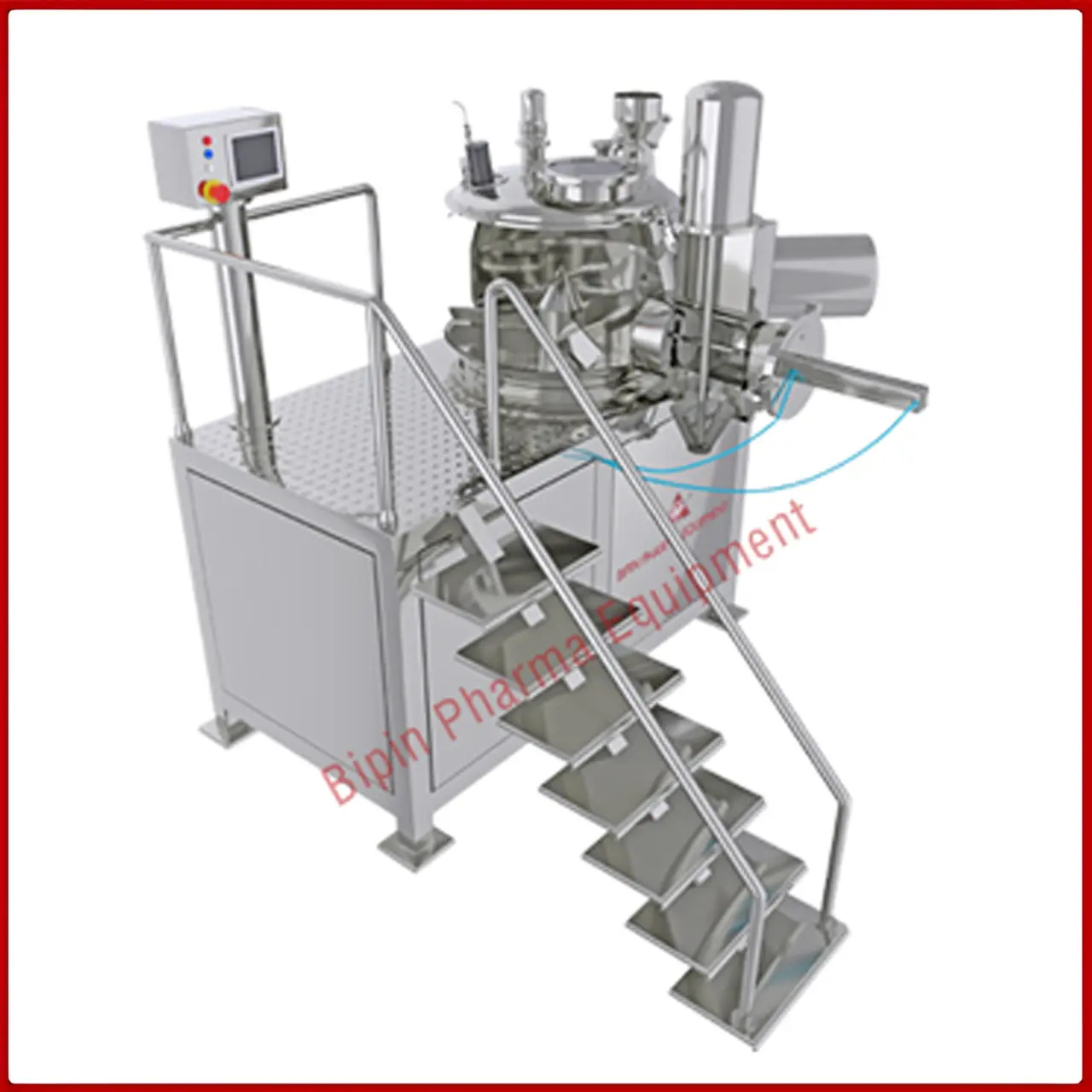
Rapid Mixer GranulatorSS316L bowl and agitator; bottom discharge valve with no dead zone; mechanical seal on impeller shaft; HEPA vent filter; CIP spray balls; bowl lift / tilt for access; ATEX motor if solvent granulation used
Fluid Bed DryerSS316L product container and expansion chamber; HEPA filtered inlet air; explosion-proof (ATEX) motor and electrical components; anti-static bag filter; validated temperature uniformity; inlet air temperature and humidity control
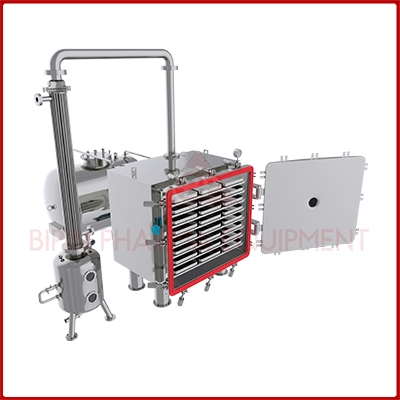
Vacuum Tray DryerSS316L trays and chamber; jacket for uniform heating; vacuum integrity (leak rate <1 mbar/hr); validated temperature mapping of all shelf positions; solvent condenser and receiver for organic solvent drying
Double Cone Blender / Octagonal BlenderSS316L contact surfaces; sanitary butterfly valves for discharge; clean-in-place spray nozzles inside; no exposed bolts or screw threads on product-contact surfaces; variable speed drive with RPM display; dust-proof motor
Vibro SifterSS316L contact parts; validated mesh with documented mesh size certification; easy disassembly for cleaning; sealed connections to prevent dust escape; GMP motor with no fibrous insulation near product path
Coating PanSS316L perforated pan; variable pan speed and spray rate; HEPA filtered inlet air; exhaust solvent capture system; validated spray gun arrangement for uniform coverage; ATEX motor for solvent-based coating
Sparkler Filter Press / Zero Hold Up Filter PressSS316L housing and all product-contact components; complete drainability; CIP compatibility; filter media validation (compatibility + extraction); pressure-rated certification; no dead legs in piping connections
SS ReactorSS316L product-contact surfaces; pressure vessel code certification (ASME / IBR); mechanical seal on agitator; safety relief valve + rupture disc; ATEX-rated electrical components; full documentation package (DQ, FAT, SAT, IQ)
Sterile Manufacturing VesselSS316L electropolished (Ra ≤ 0.4 µm); Tri-Clamp fittings throughout; SIP/CIP compatible; 0.2 µm vent filters on all open connections; full orbital weld documentation; IQ/OQ/PQ validation package
Multi Column Distillation PlantSS316L electropolished throughout; validated mist eliminators; online conductivity monitoring; automatic divert system; 21 CFR Part 11 compliant data logging; full IQ/OQ/PQ documentation

5. Validation Documentation: What GMP Equipment Must Come With

A GMP-compliant pharmaceutical equipment manufacturer must supply a complete validation documentation package with every piece of equipment. This documentation is required for the equipment qualification process (IQ, OQ, PQ) and for regulatory inspection readiness. When evaluating a supplier, always ask for and review the documentation package they provide.

Complete GMP Equipment Documentation Package — What to Expect

  • DQ (Design Qualification) — documents that the equipment design meets the specified User Requirements Specification (URS)
  • FAT (Factory Acceptance Testing) — testing at the manufacturer's facility before delivery; verifies equipment performs to specification before shipping
  • SAT (Site Acceptance Testing) — testing at your facility after installation; confirms equipment performs correctly in your environment
  • IQ (Installation Qualification) template — documents what was installed, where, and to what specification; verifies correct utilities, materials, and configuration
  • OQ (Operational Qualification) template — documents that equipment operates within defined parameters across its operating range
  • PQ (Performance Qualification) protocol template — documents that equipment consistently produces product meeting specifications under production conditions
  • Material Test Certificates (MTCs) — certifies the grade and composition of all SS316L materials used
  • Weld inspection certificates — radiographic or dye penetrant test reports for pressure-containing welds
  • Pressure test certificate — hydrostatic or pneumatic pressure test report for pressure vessels
  • Calibration certificates — for all instruments supplied with the equipment (temperature, pressure, speed)
  • Surface finish (Ra) measurement report — profilometer readings for critical product-contact surfaces
  • ATEX certificate — for all explosion-rated equipment used with flammable products/solvents
  • Spare parts list — with part numbers, lead times, and recommended initial stock quantities

6. Red Flags: Signs That Equipment May Not Be GMP Compliant

Red FlagWhat it IndicatesRisk
Generic "stainless steel" without specifying SS316LMay be SS304 or inferior gradeCorrosion contamination; regulatory non-compliance
No material test certificates availableMaterial traceability cannot be establishedRegulatory non-compliance; product contamination risk
"Mirror finish" claimed without Ra measurement dataSurface roughness has not been quantified or verifiedCleaning validation failure; microbial attachment risk
Painted or lacquered product-contact surfacesNon-GMP surface treatment; paint can flake into productParticulate contamination; regulatory rejection
Threaded connections on product-contact pipingThreads are dead zones that harbour product and resist cleaningCross-contamination; cleaning validation failure
No IQ/OQ documentation package availableSupplier has not designed equipment with validation in mindQualification failure; regulatory inspection failure
Standard industrial motors without ATEX rating near flammable productsIgnition risk in presence of flammable solvents or powdersFire, explosion, serious safety incident
Rubber gaskets and seals without material certificationUnknown extractables and leachables into productProduct contamination; patient safety risk
Welds with visible porosity, undercut, or incomplete penetrationPoor weld quality; product traps; corrosion initiation pointsProduct contamination; cleaning failures; equipment failure
No spare parts list or after-sales support commitmentLong-term maintenance risk; production downtimeEquipment availability; compliance risk

7. Master GMP Equipment Evaluation Checklist

Use this checklist when evaluating any pharmaceutical equipment supplier or conducting a Factory Acceptance Test (FAT):

Material & Construction

  • All product-contact surfaces confirmed as SS316L with MTCs available
  • All gaskets and seals are pharmaceutical-grade (PTFE, EPDM, silicone) with certification
  • No paint, lacquer, or non-validated coatings on product-contact surfaces
  • Lubricants are pharmaceutical-grade (NSF H1 or food-grade equivalent)

Surface Finish

  • Ra values for product-contact surfaces specified and documented
  • Electropolished surfaces for oral liquid, sterile, or WFI applications
  • Weld quality: full-penetration butt welds; pickled and passivated; no visible defects
  • Surface finish measurement report (profilometer readings) available

GMP Design Features

  • No dead legs in pipework; all piping self-draining by gravity
  • CIP/WIP spray coverage of all internal product-contact surfaces confirmed
  • No threaded connections on product-contact surfaces (Tri-Clamp / sanitary fittings used)
  • Complete drainability confirmed — no product retaining pockets
  • Mechanical seals on all rotating shafts (no packing glands)
  • ATEX-rated electrical components if flammable product or solvent contact is possible

Documentation

  • DQ / URS confirmation available
  • FAT protocol and report available / to be provided
  • IQ, OQ template documentation provided
  • Material Test Certificates (MTCs) for all SS316L components
  • Pressure test / hydrostatic test certificate (for pressure vessels)
  • Calibration certificates for all instruments
  • Surface finish Ra measurement report
  • ATEX certificate (if applicable)
  • Weld inspection certificates
  • Spare parts list with part numbers

Frequently Asked Questions (FAQ)

What is the difference between SS304 and SS316L in pharmaceutical equipment?
SS304 and SS316L are both austenitic stainless steels, but SS316L has two important additions that make it the GMP standard for pharmaceutical equipment: it contains 2–3% molybdenum, which provides significantly better resistance to chloride pitting and crevice corrosion — particularly important when cleaning with chlorine-based sanitisers; and the "L" designation means its carbon content is ≤ 0.03%, which prevents sensitisation (chromium carbide precipitation at weld heat-affected zones) that can create corrosion-prone areas on SS316 or SS304. All pharmaceutical GMP regulations specify SS316L (not SS304 or SS316) for product-contact surfaces. When a supplier quotes "stainless steel" without specifying the grade, always ask to confirm it is SS316L and request material test certificates.
What is electropolishing and when is it required for pharmaceutical equipment?
Electropolishing is an electrochemical surface treatment that removes the outer layer of metal from stainless steel surfaces, resulting in an exceptionally smooth, bright surface with Ra ≤ 0.4 µm. It also removes embedded iron particles, enhances the passive chromium oxide layer, and reduces micro-pits where biofilm can form. Electropolished surfaces are required for oral liquid manufacturing vessels and pipework, sterile manufacturing vessels and WFI distribution systems, any equipment where microbial attachment is a critical risk, and where cleaning validation requires Ra ≤ 0.4 µm to demonstrate surface cleanability. For oral solid dosage form equipment (tablets, capsules), mechanical polishing to Ra ≤ 0.8 µm is generally sufficient — electropolishing is not always required unless the manufacturer's specification or regulatory requirement specifically demands it.
What is a Factory Acceptance Test (FAT) and why should I insist on one?
A Factory Acceptance Test (FAT) is a formal testing exercise conducted at the equipment manufacturer's facility before the equipment is shipped to your site. During the FAT, the equipment is operated (typically with water or test material) and tested against a pre-agreed FAT protocol to confirm it meets all specified requirements — dimensions, materials, operating parameters, safety features, and documentation completeness. The FAT is the last opportunity to identify and correct non-conformances before the equipment leaves the manufacturer's facility — which is far less expensive than correcting them after installation at your site. Insisting on a documented FAT (with FAT protocol, test results, and punch list of corrective actions) is a strong indicator of a manufacturer's commitment to GMP quality and significantly de-risks your equipment procurement process.
What ATEX requirements apply to pharmaceutical equipment?
ATEX (ATmosphères EXplosibles) certification is required for all electrical equipment used in areas where there is a risk of explosive atmosphere from flammable solvents, vapours, or dusts. In pharmaceutical manufacturing, ATEX requirements apply to equipment used with organic solvents (reactors, distillation systems, ANFD, solvent-based coating pans, fluid bed dryers with organic solvent spraying), equipment generating fine pharmaceutical powders with explosion potential (fluid bed dryers, granulators), and equipment in areas classified as ATEX Zone 1 or Zone 2. The ATEX Directive 2014/34/EU (EU) and equivalent Indian IS standards require that all motors, sensors, instruments, and electrical components in hazardous zones carry the appropriate ATEX certification and Ex marking. Always confirm ATEX certification when purchasing any equipment that will handle flammable solvents or produce fine dust.
How do I verify that a pharmaceutical equipment manufacturer in India is genuinely GMP compliant?
Verifying genuine GMP compliance of an equipment manufacturer requires looking beyond marketing claims. Key verification steps include: requesting and reviewing sample material test certificates (MTCs) for SS316L components from recent orders; requesting sample IQ/OQ documentation for a comparable piece of equipment; asking for Ra measurement reports for product-contact surfaces; visiting the manufacturing facility to inspect fabrication quality, welding, and surface finishing firsthand; checking if the manufacturer has supplied equipment to regulated market customers (FDA-registered, EU GMP-approved facilities) and asking for references; verifying if they carry out FAT testing with documented protocols; and confirming their after-sales support capability for spare parts and technical service. A genuine GMP equipment manufacturer will be able to provide all of the above without hesitation.

Conclusion

GMP-compliant pharmaceutical equipment is not just about stainless steel and smooth surfaces — it is a comprehensive design philosophy that encompasses material traceability, surface finish verification, cleanability by design, containment, validation documentation, calibration, and long-term serviceability. Every purchasing decision for pharmaceutical manufacturing equipment should be evaluated against the criteria in this guide to ensure your investment is protected, your facility is inspection-ready, and your product quality is never compromised by equipment design shortcomings.

Every piece of pharmaceutical equipment we manufacture — from Rapid Mixer Granulators and Fluid Bed Dryers to SS Reactors, ANFDs, Sterile Manufacturing Vessels, and Multi Column Distillation Plants — is designed, fabricated, and documented to full GMP standards, with complete material traceability, validated surface finishes, and comprehensive IQ/OQ documentation support.

Enquire About Our GMP-Compliant Pharmaceutical Equipment

Speak with our technical team to discuss your specific GMP requirements, documentation needs, and equipment specifications.

Send Enquiry Contact Us

Related Article Pages