How Vacuum Drying Works in Pharmaceutical Manufacturing: Principles, Equipment & Applications
Vacuum drying is one of the most important and scientifically elegant drying technologies available to pharmaceutical manufacturers. By combining reduced pressure with gentle heat transfer, vacuum drying achieves what no other conventional dryer can — the complete removal of moisture and organic solvents from heat-sensitive, solvent-laden, or hygroscopic materials at remarkably low temperatures.
From drying a temperature-sensitive API intermediate at 35°C to recovering high-value organic solvents from a pharmaceutical synthesis batch, vacuum drying technology sits at the heart of quality-critical pharmaceutical and chemical manufacturing. This article explains the science behind vacuum drying, the equipment involved, process parameters, applications, and how vacuum drying integrates into the broader pharmaceutical manufacturing workflow.
We are a leading manufacturer, supplier, and exporter of Vacuum Tray Dryers and complete drying systems for pharmaceutical, chemical, and nutraceutical manufacturers in India and worldwide.
The Science of Vacuum Drying: Why Reduced Pressure Enables Low-Temperature Drying
The fundamental principle behind vacuum drying is the relationship between vapour pressure and boiling point. At atmospheric pressure (1013 mbar), water boils at 100°C. However, the boiling point of any liquid decreases as ambient pressure decreases. Under vacuum, the partial pressure of vapour above the liquid surface is reduced, allowing molecules to escape the liquid phase at much lower temperatures.
This relationship is illustrated in the table below:
| Vacuum Level (mbar) | Boiling Point of Water (°C) | Typical Application |
|---|---|---|
| 1013 (atmospheric) | 100°C | Standard tray dryer |
| 200 mbar | 60°C | Moderate heat-sensitive materials |
| 100 mbar | 46°C | Heat-sensitive APIs |
| 50 mbar | 33°C | Highly heat-sensitive APIs |
| 20 mbar | 22°C | Thermolabile biologics, enzymes |
| 5 mbar | 0°C (freeze drying range) | Lyophilisation / freeze drying |
This dramatic reduction in evaporation temperature is the key advantage of vacuum drying. A pharmaceutical API that degrades at temperatures above 50°C can be safely dried at 35°C under an appropriate vacuum level — preserving chemical integrity, polymorphic form, and biological activity.
How a Vacuum Tray Dryer Works: Step-by-Step
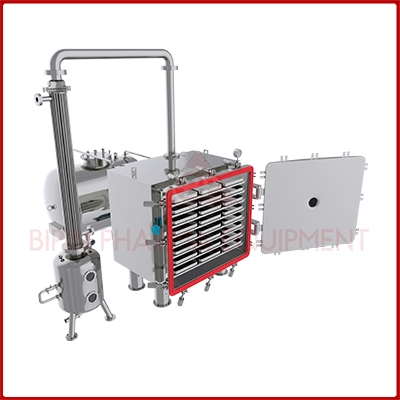
The Vacuum Tray Dryer operates through a carefully orchestrated combination of conductive heat transfer, vacuum generation, and vapour removal. Here is how the process works step by step:
Step 1: Product Loading
The wet product — which may be a pharmaceutical API cake from filtration, a granule batch, a paste, or a powder — is spread in a thin, uniform layer on stainless steel trays. Tray loading depth is typically 10 to 25 mm for granular materials and up to 40 mm for pastes, depending on thermal conductivity and required drying rate. Loaded trays are placed on the hollow heated shelves inside the vacuum chamber.
Step 2: Chamber Sealing and Vacuum Generation
The vacuum chamber door is closed and sealed using a silicone gasket that provides a reliable vacuum-tight seal. The vacuum pump is started and progressively evacuates the chamber to the target vacuum level — typically achieved in 10 to 20 minutes depending on chamber volume. Vacuum pump types include liquid ring pumps (preferred for solvents), rotary vane pumps (for aqueous drying), and dry screw pumps (for potent/cleanroom applications).
Step 3: Conductive Heating
The hollow shelves are heated by circulating hot water or steam at the target temperature — typically 40°C to 80°C for pharmaceutical applications. Heat is conducted from the shelf surface through the stainless steel tray and into the product layer. This conductive heat transfer is the primary mechanism of energy input in a Vacuum Tray Dryer, distinguishing it from convective dryers like the Tray Dryer and Fluid Bed Dryer.
Step 4: Evaporation and Vapour Removal
Under the combined effect of shelf heating and reduced chamber pressure, moisture and solvent vapours evaporate from the product surface and migrate through the product bed towards the chamber vapour space. The vacuum pump continuously removes these vapours from the chamber, maintaining the low-pressure environment that sustains low-temperature evaporation.
Step 5: Solvent Recovery (where applicable)
When drying materials containing organic solvents, a refrigerated condenser is installed between the vacuum chamber and the vacuum pump. Solvent vapours passing through the condenser are condensed back to liquid and collected in a receiver vessel. This recovers valuable solvents for reuse and prevents solvent vapours from entering and damaging the vacuum pump. Condensers are essential for ICH Q3C-compliant residual solvent reduction.
Step 6: Drying Endpoint Determination
The drying endpoint is determined by periodic LOD (Loss on Drying) testing of product samples withdrawn through a sampling port, or by monitoring the vacuum gauge — a stabilising vacuum reading indicates no further vapour generation and confirms drying is complete. Advanced VTD systems include inline moisture sensors for continuous endpoint monitoring.
Step 7: Vacuum Release and Product Discharge
Once the target LOD is achieved, the vacuum is released by admitting filtered, dry nitrogen (preferred for oxygen-sensitive APIs) or dry filtered air into the chamber. The chamber is brought back to atmospheric pressure, the door is opened, and the dried product is discharged from the trays into sealed containers or IPC Bins for transfer to the next processing stage.
Key Components of a Vacuum Tray Dryer System
| Component | Function |
|---|---|
| Vacuum chamber | Sealed SS316L enclosure housing the heated shelves and product trays |
| Heated shelves | Hollow SS shelves carrying hot water or steam; primary heat source via conduction |
| Stainless steel trays | Product containers placed on shelves; SS316L with smooth finish |
| Vacuum pump | Generates and maintains vacuum; type depends on solvent (liquid ring for solvents) |
| Condenser | Condenses and recovers solvent / water vapours before vacuum pump |
| Receiver vessel | Collects condensed solvent or water from condenser |
| Vacuum gauge / transducer | Monitors and controls chamber pressure |
| Temperature sensors (RTD) | Monitors shelf temperature, product temperature, and condenser temperature |
| PLC control panel | Automated control of vacuum, temperature, and drying cycle |
| Nitrogen inlet valve | Admits dry N₂ for vacuum release (for oxygen-sensitive products) |
| Sampling port | Enables in-process LOD sampling without breaking vacuum |
Vacuum Drying Parameters and Their Effects
| Process Parameter | Typical Range | Effect on Drying |
|---|---|---|
| Shelf temperature | 40–90°C | Higher temp = faster drying; limited by API thermal stability |
| Vacuum level | 10–100 mbar | Deeper vacuum = lower boiling point = lower product temp |
| Tray loading depth | 10–40 mm | Thinner layer = faster drying; thicker = longer cycle time |
| Heating medium temp | 50–120°C | Drives conductive heat flux to product |
| Condenser temperature | -10 to +10°C | Lower = better solvent condensation efficiency |
| Vacuum pump capacity | Process-specific | Higher capacity = faster vacuum draw-down |
| Product layer density | Material-specific | Denser materials require longer drying cycles |
Pharmaceutical Applications of Vacuum Drying
1. API Drying After Synthesis and Filtration
The most critical application of vacuum drying in pharmaceuticals is the final drying of APIs after chemical synthesis, crystallisation, and filtration. The wet API cake — typically discharged from an Agitated Nutsche Filter (ANFD) or Nutsche Filter — contains residual organic solvents that must be reduced to ICH Q3C limits (typically <100 to 5,000 ppm depending on solvent class). The Vacuum Tray Dryer, with its solvent recovery capability, is uniquely suited to this application.
2. Drying of Heat-Sensitive APIs
Many modern APIs — including peptides, proteins, polymorphic compounds, and temperature-labile small molecules — are chemically unstable at temperatures above 40–60°C. Conventional tray drying or fluid bed drying at 60–80°C causes degradation, colour change, or polymorphic conversion. Vacuum drying at 30–45°C under deep vacuum safely removes moisture without thermal stress.
3. Drying of Hygroscopic Materials
Highly hygroscopic APIs and excipients rapidly re-absorb moisture from the surrounding air during conventional drying. The sealed vacuum chamber environment completely eliminates atmospheric moisture exposure during drying and cooling, making the Vacuum Tray Dryer the only practical option for drying extremely hygroscopic compounds.
4. Granule Drying in Pilot and Development Scale
While the Fluid Bed Dryer is preferred at commercial scale for granule drying, the Vacuum Tray Dryer is frequently used at pilot and development scale for drying wet granules — particularly when the granule formulation contains a heat-sensitive API, an organic solvent-based binder, or when fluid bed fluidisation is difficult due to granule density or cohesiveness.
5. Drying in Chemical Reactor-Based Manufacturing
In chemical synthesis plants, the Vacuum Tray Dryer works downstream of SS Reactors and filtration equipment. After reaction completion, the product is filtered and the wet cake is transferred to the Vacuum Tray Dryer for residual solvent removal. The solvent vapours are condensed and recovered via the condenser-receiver system, enabling solvent reuse and environmental compliance.
Vacuum Drying vs Alternative Drying Technologies
| Feature | Vacuum Tray Dryer | Tray Dryer | Fluid Bed Dryer | Spray Dryer |
|---|---|---|---|---|
| Min. drying temp possible | ~25°C | ~50°C | ~40°C | ~60°C (outlet) |
| Solvent recovery | Yes | No | Limited | No |
| Heat-sensitive APIs | Excellent | Poor | Moderate | Moderate |
| Sticky / paste materials | Yes | Yes | No | No |
| Drying speed | Moderate | Slow | Fast | Very fast |
| Capital cost | High | Low | Moderate | High |
| GMP containment | Excellent | Moderate | Good | Moderate |
GMP and Regulatory Considerations for Vacuum Drying
Vacuum drying in pharmaceutical manufacturing must comply with applicable GMP regulations. Key regulatory and quality requirements include:
- Vacuum Tray Dryer must be qualified with IQ, OQ, and PQ protocols
- Temperature mapping across all shelf positions required during qualification
- Vacuum integrity testing (leak rate testing) must be part of OQ and routine maintenance
- Condenser and receiver vessel must be validated for solvent recovery efficiency
- Residual solvent testing of dried API required per ICH Q3C guidelines
- All product-contact surfaces must be SS316L with Ra ≤ 0.8 µm surface finish
- Nitrogen blanketing systems must be tested for purity and integrity
- Cleaning validation required for all product-contact components after each product campaign
- Batch records must include vacuum level, shelf temperature, drying duration, and LOD results
Frequently Asked Questions (FAQ)
Conclusion
Vacuum drying is a technically sophisticated and indispensable drying technology in pharmaceutical and chemical manufacturing. Its ability to dry materials at temperatures as low as 25–35°C, recover organic solvents, and maintain a completely sealed product environment makes it the only viable drying solution for heat-sensitive APIs, solvent-containing intermediates, and hygroscopic compounds.
The Vacuum Tray Dryer works seamlessly within a complete pharmaceutical processing line that includes Nutsche Filters for upstream filtration, SS Reactors for chemical synthesis, and downstream granulation and blending equipment for formulation manufacturing.
We manufacture and export GMP-compliant Vacuum Tray Dryers in a wide range of capacities for pharmaceutical, API, chemical, and nutraceutical manufacturers.
Enquire About Our Vacuum Tray Dryers
Speak with our technical team for expert guidance on vacuum drying equipment selection, specifications, and pricing.
Send Enquiry Contact Us