Terms & Conditions Privacy Policy Disclaimer

Oral Liquid Manufacturing: Key Equipment & GMP Compliance Guide for Pharma Manufacturers

Oral liquid dosage forms — syrups, suspensions, elixirs, drops, and oral solutions — represent one of the most widely consumed categories of pharmaceutical products worldwide. They offer significant advantages over solid dosage forms in terms of ease of swallowing, flexible dosing, and rapid absorption. However, manufacturing oral liquids to pharmaceutical-grade quality demands a precisely designed plant, stringent process controls, a robust filtration system, and full compliance with GMP regulations.

This guide provides a complete overview of oral liquid manufacturing — covering dosage form types, the manufacturing process, every key piece of equipment, filtration system selection, quality control requirements, and the GMP standards that govern oral liquid production in India and globally.

We are a leading manufacturer, supplier, and exporter of Oral Liquid Systems, Syrup Manufacturing Plants, and complete filtration solutions for pharmaceutical manufacturers across India and internationally.

Why Oral Liquid Dosage Forms Are Important

Oral liquids are a preferred dosage form across multiple patient segments and therapeutic categories. Their key advantages include:

  • Ease of administration for paediatric patients, elderly, and dysphagia patients who cannot swallow tablets or capsules
  • Flexible dose adjustment — dose can be titrated by volume rather than tablet fraction
  • Faster onset of action compared to solid dosage forms — no disintegration step required
  • Homogeneous dose uniformity achievable with validated manufacturing processes
  • Wide range of APIs can be formulated as stable liquid dosage forms
  • Better patient compliance for long-term therapies in vulnerable populations

The global oral liquid pharmaceutical market is one of the fastest-growing segments in the industry, driven by increasing paediatric formulation requirements, growing geriatric populations, and rising demand for liquid nutraceuticals and herbal preparations.

Types of Oral Liquid Dosage Forms

Dosage FormDefinitionKey CharacteristicsExamples
SyrupConcentrated aqueous sugar solution with dissolved APIHigh sugar content, viscous, sweet tasteCough syrup, antihistamine syrup, iron syrup
SuspensionInsoluble API dispersed in liquid vehicleRequires shaking before use; settles on standingAntacid suspension, amoxicillin suspension
ElixirHydroalcoholic solution with sweeteners and flavoursClear, aromatic, pleasant tastePaediatric multivitamin tonic, herbal elixir
Oral SolutionAPI fully dissolved in aqueous or non-aqueous vehicleClear, homogeneous, no shaking neededElectrolyte solution, paracetamol drops
Oral DropsConcentrated liquid for administration in small volumes via dropperHigh concentration, small dose volume (0.1–1 mL)Vitamin D drops, iron drops, antibiotic drops
LinctusViscous syrup-based formulation for local action on throatHigh viscosity to prolong contact with throat mucosaCough linctus, expectorant linctus
EmulsionTwo-phase liquid with oil dispersed in aqueous vehicleRequires emulsifier for stability; may separate on standingLiquid paraffin emulsion, fish oil emulsion

Oral Liquid Manufacturing Process Overview

The manufacturing of non-sterile oral liquid pharmaceutical products follows a defined sequence of GMP-controlled operations. While the specific process varies by formulation type (solution, suspension, emulsion), the general workflow is consistent across most oral liquid products:

StepUnit OperationKey EquipmentCritical Control
1Purified Water generationWater Treatment System (RO + UV)Conductivity, TOC, microbial count
2Sugar syrup preparationSugar Dissolving VesselTemperature 70–80°C, Brix concentration
3API & excipient dissolution / dispersionManufacturing VesselTemperature, agitation speed, dissolution time
4Volume make-up to final batch sizeManufacturing Vessel with calibrated dip tubeFinal volume accuracy (±1%)
5In-process quality checks (IPQC)Sampling valve, QC laboratorypH, Brix, viscosity, assay, clarity
6Filtration / clarificationSparkler Filter Press / Zero Hold Up Filter PressFilter integrity, particle count, clarity
7Bulk storage prior to fillingStorage VesselTemperature, nitrogen blanketing, hold time
8Filling and sealingLiquid filling machineFill volume accuracy, container integrity
9Labelling and packingLabelling / cartoning machineLabel content accuracy, batch coding

Key Equipment in Oral Liquid Manufacturing

1. Oral Liquid Systems

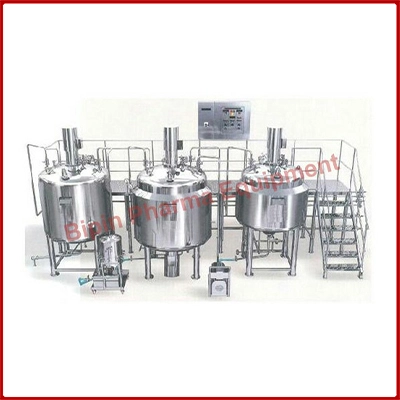
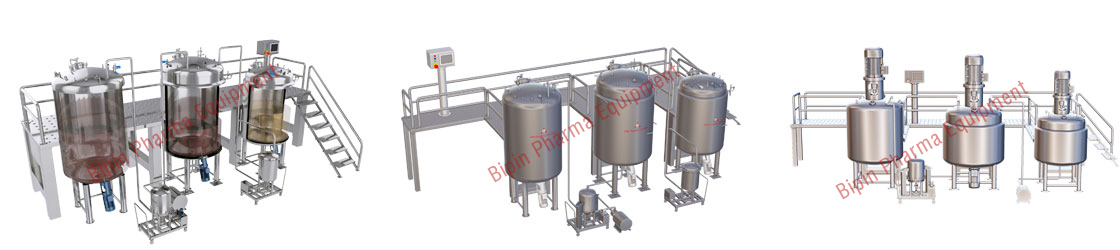
The Oral Liquid Systems from our range are complete, integrated, GMP-compliant manufacturing solutions for pharmaceutical syrups, suspensions, elixirs, and oral solutions. Each system is engineered to meet the specific formulation, capacity, and regulatory requirements of the manufacturer — from compact pilot-scale units to large-scale commercial production plants.

Key Features of Oral Liquid Systems

  • Integrated Sugar Dissolving Vessel, Manufacturing Vessel, and Storage Vessel in SS316L
  • Mirror-polished internal surfaces (Ra ≤ 0.4 µm) for validated cleanability
  • Jacketed vessels with steam/hot water/chilled water utility connections
  • Variable-speed agitators with mechanical seals for contamination-free mixing
  • CIP (Clean-in-Place) spray balls in all vessels for automated cleaning
  • Calibrated sight glass and dip tubes for precise volume measurement
  • Dedicated sampling valves for aseptic in-process sampling
  • Nitrogen inlet and blanketing system for oxygen-sensitive formulations
  • PLC-based control panel with HMI for automated parameter monitoring
  • Capacities from 100 L to 10,000 L per batch; custom configurations available

2. Syrup Manufacturing Plant

The Syrup Manufacturing Plant is the most commonly deployed oral liquid manufacturing system in pharmaceutical facilities producing sugar-based syrups and oral solutions. It incorporates the complete vessel set — Sugar Dissolving Vessel (SDV), Manufacturing Vessel (MV), and Storage Vessel (SV) — with all interconnecting pipework, pumps, and controls in a single GMP-compliant installation. The plant is available in standard capacities and can be customised for specific batch sizes, utility requirements, and cleanroom integration.

3. Filtration System

Filtration is a mandatory step in oral liquid manufacturing for particulate removal, product clarification, and microbial count reduction. Two key filter press types are used in pharmaceutical oral liquid filtration:

Sparkler Filter Press

The Sparkler Filter Press is a horizontal leaf pressure filter widely used for clarification and polishing of pharmaceutical syrups, oral solutions, and other liquid formulations. The product is forced through a stack of circular filter leaves under pressure, removing fine particles and filter aid cake efficiently. The Sparkler Filter Press is available in SS316L with GMP-compliant design and is used as the primary clarification filter in most oral liquid manufacturing plants.

Key Features of Sparkler Filter Press

  • Horizontal leaf filter design for efficient cake formation and clarification
  • SS316L stainless steel construction throughout
  • Available in multiple filter areas to suit batch volumes from 50 L to 10,000 L
  • Filter leaves in SS316L mesh or polypropylene for different filtration grades
  • Pressure-rated construction for operating pressures up to 5 bar
  • Easy access for filter leaf cleaning and replacement
  • Suitable for viscous liquids, syrups, and solutions containing filter aids (Diatomaceous Earth)
  • GMP-compliant design with minimal dead volume and complete drainability

Zero Hold Up Filter Press

The Zero Hold Up Filter Press is designed specifically for maximum product recovery in pharmaceutical oral liquid filtration. Unlike conventional filter presses where a significant volume of product is retained in the filter housing after filtration, the Zero Hold Up Filter Press is engineered to recover virtually 100% of the product — leaving essentially no residual product in the filter after the filtration cycle is complete.

Key Features of Zero Hold Up Filter Press

  • Zero dead volume design — virtually complete product recovery after filtration
  • SS316L stainless steel with mirror-polished product-contact surfaces
  • Ideal for high-value API formulations where product loss is commercially significant
  • Filter plates in polypropylene or SS for various filtration grades
  • Compact, closed design prevents product contamination during filtration
  • Easy disassembly and CIP compatibility for rapid changeover
  • Available for batch volumes from 50 L to 5,000 L
  • Pressure-rated to 5 bar for efficient filtration of viscous oral liquids

Sparkler Filter Press vs Zero Hold Up Filter Press: When to Use Which

ParameterSparkler Filter PressZero Hold Up Filter Press
Primary applicationBulk clarification and polishing of syrups and solutionsFiltration of high-value products requiring maximum yield
Product recoveryGood (small residual product in filter)Excellent — virtually zero product loss
Filtration capacityHigh — suitable for large batch volumesModerate — optimised for yield over throughput
Use of filter aid (DE)Yes — commonly used with Diatomaceous EarthGenerally without filter aid for maximum recovery
Viscous productsExcellent — handles high-viscosity syrups wellGood — suitable for moderate viscosity products
Cleaning / CIPManual leaf cleaning; CIP-compatible housingEasy plate disassembly; full CIP compatible
API value considerationStandard API value productsHigh-value / costly API formulations
Common use inSyrup, oral solution, vitamin formulationsAntibiotic suspensions, high-cost specialty syrups

In-Process and Finished Product Quality Control in Oral Liquid Manufacturing

Comprehensive quality control is mandatory at every stage of oral liquid manufacturing. Key tests and checks include:

Test / CheckStageAcceptance Criteria
Purified Water qualityBefore useConductivity ≤ 4.3 µS/cm; TOC ≤ 500 ppb; microbial ≤ 100 CFU/mL
Brix (sugar concentration)After sugar dissolutionFormulation-specific; typically 55–65° Brix
pHIn-process and finished productFormulation-specific; typically 3.0–7.0
Clarity (for solutions)In-process and post-filtrationClear; NTU ≤ specified limit
ViscosityIn-processFormulation-specific (cP); affects fill accuracy
API assay (potency)In-process and finished product90–110% of label claim (pharmacopoeial range)
Microbial countBulk before fillingTAMC ≤ 100 CFU/mL; TYMC ≤ 10 CFU/mL (non-sterile oral)
Fill volume / weightDuring fillingWithin ±1–2% of target fill volume
Preservative contentFinished productWithin specification per validated assay method
Particulate matterPost-filtration and filled productComplies with pharmacopoeial visible particulate test

GMP Requirements for Oral Liquid Manufacturing

Oral liquid pharmaceutical manufacturing must comply with applicable GMP regulations — US FDA 21 CFR Part 211, WHO GMP TRS 986, Schedule M (India), and EU GMP Annex 1 / Annex 15. Key requirements include:

Facility and Environment

  • Manufacturing area must be Grade D (EU GMP) or equivalent — HEPA-filtered air, positive pressure, controlled temperature (20–25°C) and humidity
  • Filling area should be Grade C or better to minimise microbial contamination risk during filling into open containers
  • Manufacturing and filling areas must have smooth, impervious, cleanable wall, floor, and ceiling surfaces
  • Separate dispensing, manufacturing, filling, and packing areas with defined airlocks

Equipment and Vessels

  • All product-contact surfaces must be SS316L with Ra ≤ 0.4 µm mirror-polished or electropolished finish
  • No dead legs in pipework — all pipelines must drain completely by gravity
  • All vessels must have CIP spray balls validated for cleaning efficiency by TOC / swab testing
  • Agitators must have mechanical seals with validated leak-free operation
  • All instruments (temperature sensors, pH meters, flow meters) must be calibrated on a validated schedule

Water System

  • Purified Water must be generated by a validated multi-stage treatment system (pre-filtration, softening, RO, UV, polishing)
  • Purified Water must be monitored daily for conductivity, TOC, pH, and microbial count at each point of use
  • The Purified Water loop must be sanitised (hot water or chemical) on a validated frequency
  • Water system design must eliminate dead legs and use electropolished SS316L pipework

Validation and Documentation

  • IQ, OQ, and PQ validation required for all manufacturing vessels, filtration systems, filling machines, and utilities
  • Cleaning validation with TOC and swab testing required after each product campaign
  • Process validation for all commercial products — minimum 3 consecutive batches meeting specifications
  • Batch records must document all critical parameters, deviations, IPQC results, and yield calculations
  • Stability studies required for all oral liquid formulations — at least 24 months at specified storage conditions

Common Quality Defects in Oral Liquid Manufacturing and Remedies

DefectLikely CauseRemedy
Cloudiness / turbidity in solutionIncomplete dissolution; microbial growth; incompatibilityOptimise dissolution temperature and time; improve filtration; check compatibility
Particulate matter in filled productFiltration failure; container contamination; API crystallisationVerify filter integrity; improve container washing; reformulate for solubility
pH out of specificationBuffer failure; CO₂ absorption; ingredient degradationAdjust buffer system; seal containers against CO₂; review shelf life data
Microbial contaminationInadequate preservative; manufacturing area contamination; poor CIPOptimise preservative system; improve CIP validation; enhance environmental monitoring
API content low (out of assay)Incomplete dissolution; sorption onto container; degradationReview dissolution process; change container material; improve formulation stability
Sedimentation in suspensionInadequate suspending agent; incorrect particle sizeOptimise suspending agent concentration; control API particle size; add wetting agent
Crystallisation on storageAPI supersaturation; temperature cyclingReduce API concentration; add solubiliser; specify storage temperature

Regulatory Framework for Oral Liquid Manufacturing in India

Pharmaceutical oral liquid manufacturing in India is governed by the following key regulations and guidelines:

  • Drugs and Cosmetics Act, 1940 and Rules, 1945 — primary regulatory framework for pharmaceutical manufacturing in India
  • Schedule M (Revised) — Good Manufacturing Practices for Premises and Materials — mandates GMP requirements for all dosage forms including oral liquids
  • Indian Pharmacopoeia (IP) — defines quality standards for Purified Water, oral liquid dosage forms, and individual monographs
  • CDSCO Guidelines — Central Drugs Standard Control Organisation guidelines for new drug approvals, site registration, and GMP inspections
  • WHO GMP (TRS 986) — adopted as the international standard for WHO-prequalified oral liquid manufacturers exporting to regulated markets
  • US FDA 21 CFR Parts 210 and 211 — required for manufacturers supplying the US market
  • EU GMP Annex 1 and Annex 15 — required for manufacturers supplying EU markets; Annex 15 covers qualification and validation

Frequently Asked Questions (FAQ)

What is the difference between Oral Liquid Systems and a Syrup Manufacturing Plant?
A Syrup Manufacturing Plant is a specific configuration designed primarily for sugar-based syrups and oral solutions, typically including a Sugar Dissolving Vessel, Manufacturing Vessel, and Storage Vessel. Oral Liquid Systems is a broader term referring to the complete integrated manufacturing solution for any oral liquid dosage form — including syrups, suspensions, elixirs, emulsions, and oral drops. The Oral Liquid System may include additional vessels, homogenisers, or special agitation systems depending on the formulation type.
Which filtration equipment is best for pharmaceutical syrup clarification?
For general pharmaceutical syrup clarification, the Sparkler Filter Press is the most widely used filter press — it handles high viscosity syrups efficiently and can be used with Diatomaceous Earth filter aid for superior clarity. The Zero Hold Up Filter Press is preferred when maximum product recovery is the priority — particularly for high-value API formulations or small batch specialty syrups where product loss must be minimised.
What GMP environment grade is required for oral liquid manufacturing?
Non-sterile oral liquid manufacturing requires a Grade D (EU GMP) controlled environment for the manufacturing area — HEPA-filtered air, controlled temperature (20–25°C) and humidity, positive pressure, and regular environmental monitoring. The filling area is typically classified at Grade C or higher to minimise bioburden during filling. As per Schedule M (India), the manufacturing area must be air-conditioned with defined pressure differentials and continuous environmental monitoring.
How is Purified Water quality maintained in oral liquid manufacturing?
Purified Water for oral liquid manufacturing is generated by a multi-stage treatment system — pre-filtration, activated carbon filtration, softening, reverse osmosis (RO), and UV sterilisation. The water is circulated continuously in a distribution loop maintained at elevated temperature (70–80°C for hot loop) or under UV to prevent biofilm formation. Daily monitoring of conductivity, TOC, pH, and microbial count at each point of use is mandatory. The system must be sanitised on a validated schedule and the loop must be free of dead legs.
Can one oral liquid manufacturing plant produce multiple products?
Yes. Multi-product oral liquid plants are common in contract manufacturing and generic pharmaceutical facilities. GMP compliance for multi-product facilities requires validated CIP (Clean-in-Place) cleaning between products, with cleaning verification by TOC residual testing or swab sampling and analysis. All vessels, pipelines, and pumps must be designed for complete drainability and CIP compatibility. A dedicated changeover procedure and batch record documentation are required for each product campaign.

Conclusion

Oral liquid manufacturing demands a carefully integrated combination of process vessels, mixing systems, filtration equipment, validated water systems, and rigorous quality controls — all operating within a GMP-compliant manufacturing environment. Whether you are establishing a new oral liquid facility or expanding an existing one, selecting the right equipment configuration is fundamental to product quality, regulatory compliance, and production efficiency.

Our complete oral liquid manufacturing range — Oral Liquid Systems, Syrup Manufacturing Plant, Sparkler Filter Press, and Zero Hold Up Filter Press — is manufactured to GMP standards and is available for pharmaceutical manufacturers across India and internationally.

Enquire About Our Oral Liquid Manufacturing Equipment

Speak with our technical team for expert guidance on plant configuration, equipment selection, and pricing.

Send Enquiry Contact Us

Related Article Pages