Pharmaceutical Equipment Manufacturers in India: A Complete Buyer's Guide
India is one of the world's leading manufacturers of pharmaceutical equipment — supplying GMP-compliant granulation, drying, blending, filtration, liquid manufacturing, reactor, and sterile preparation equipment to pharmaceutical companies in India and across 100+ countries. Choosing the right pharmaceutical equipment manufacturer is one of the most important and long-term decisions a pharmaceutical company makes — the equipment you purchase today will serve your facility for 15–25 years, directly impacting your product quality, regulatory compliance, and manufacturing efficiency every single day.
This comprehensive buyer's guide helps pharmaceutical manufacturers, project teams, procurement managers, and plant heads in India and internationally make informed, confident decisions when selecting a pharmaceutical equipment manufacturer — covering what to look for, how to evaluate suppliers, what questions to ask, and what documentation to demand.
Why India is a Leading Source of Pharmaceutical Equipment
India has built a globally respected pharmaceutical equipment manufacturing industry, particularly concentrated in Maharashtra (Mumbai, Pune, Thane), Gujarat (Ahmedabad, Vadodara), and Karnataka (Bengaluru). Indian pharmaceutical equipment manufacturers offer a compelling combination of advantages for buyers worldwide:
| Advantage | Details |
|---|---|
| GMP compliance | Leading Indian manufacturers build to Schedule M, EU GMP, WHO GMP, and US FDA standards — fully acceptable for regulated market pharmaceutical facilities |
| Competitive pricing | Equivalent GMP quality at 30–60% lower cost than European or US equipment — without compromising on material quality or documentation |
| Wide product range | Indian manufacturers offer complete pharmaceutical equipment portfolios — from granulation, drying, and blending to reactors, filtration, liquid manufacturing, and sterile preparation |
| Customisation capability | Indian manufacturers are highly responsive to custom specifications — capacity, material, design configuration, utility connections — often at no additional lead time |
| Export experience | Established export track record to regulated markets including EU, USA, Africa, Middle East, Southeast Asia, and Latin America — with documentation meeting international standards |
| Technical expertise | Deep process knowledge; ability to advise on equipment selection, sizing, and integration into complete manufacturing lines |
| After-sales support | Local presence for installation, commissioning, validation support, and spare parts supply — with regional service networks across India |
Types of Pharmaceutical Equipment Manufacturers in India
Not all pharmaceutical equipment manufacturers in India operate at the same level of GMP compliance, documentation capability, or product breadth. Understanding the different types helps buyers identify the right class of manufacturer for their needs:
Tier 1: Full-Range GMP Equipment Manufacturers
These manufacturers offer a comprehensive portfolio of pharmaceutical equipment across multiple product categories — granulation, drying, blending, coating, filtration, liquid manufacturing, reactors, and sterile preparation. They operate dedicated GMP manufacturing facilities, maintain full documentation packages (IQ/OQ templates, MTCs, FAT protocols), have established export credentials to regulated markets, and provide comprehensive after-sales support including installation, commissioning, and spare parts supply.
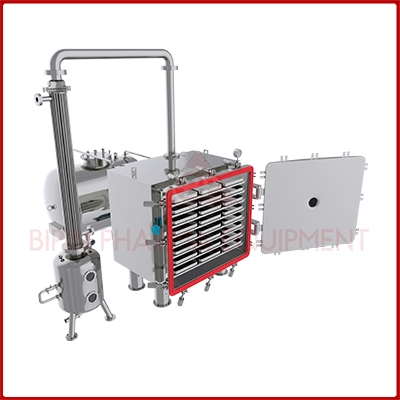
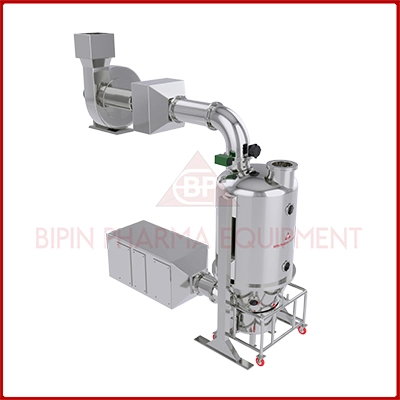
Bipin Pharma Equipment is a Tier 1 full-range pharmaceutical equipment manufacturer based in Nalasopara, Maharashtra — manufacturing and exporting the complete range of GMP pharmaceutical equipment including Rapid Mixer Granulators, Fluid Bed Dryers, Vacuum Tray Dryers, Double Cone Blenders, Coating Pans, Sparkler Filter Presses, SS Reactors, Multi Column Distillation Plants, and Sterile Manufacturing Vessels to pharmaceutical manufacturers across India and internationally.
Tier 2: Specialist Equipment Manufacturers
These manufacturers specialise in a specific equipment category — for example, only tablet compression machines, or only fluid bed dryers, or only filtration equipment. They may have deep expertise in their category but cannot supply a complete equipment package from a single source. Appropriate for buyers seeking specialist expertise in a specific area, or supplementing a broader equipment package from another supplier.
Tier 3: General Engineering / Low-Cost Manufacturers
These are general engineering workshops that fabricate pharmaceutical equipment as a secondary activity. They typically lack dedicated GMP manufacturing expertise, do not maintain complete documentation packages, may use SS304 instead of SS316L without clearly differentiating, and do not have established export credentials. Appropriate only for non-critical, non-product-contact utility equipment or pilot-scale R&D equipment — never for GMP commercial manufacturing equipment.
Key Criteria for Evaluating Pharmaceutical Equipment Manufacturers in India
1. GMP Manufacturing Facility and Processes
A genuine GMP pharmaceutical equipment manufacturer maintains a dedicated manufacturing facility where SS316L fabrication, welding, polishing, and assembly are performed under controlled conditions — with trained technicians, calibrated measuring instruments, and documented quality control procedures. Key things to assess when evaluating a manufacturer's facility:
- Dedicated pharmaceutical equipment workshop — separated from general industrial fabrication
- In-house SS316L material storage with material identification and traceability
- Qualified welders using TIG (argon arc) welding for product-contact welds
- In-house surface polishing capability — mechanical polishing and electropolishing
- Profilometer (Ra measurement instrument) for surface finish verification
- In-house hydrostatic pressure testing capability for pressure vessels
- Calibrated instruments — vernier callipers, micrometers, thermometers — with calibration records
2. Product Range and Technical Expertise
A full-range pharmaceutical equipment manufacturer with deep technical expertise in each product category provides significant advantages over a trader or assembler. Technical expertise means the manufacturer understands the process purpose of the equipment — not just its mechanical construction — and can advise on optimal equipment selection, capacity sizing, and process integration. When evaluating a manufacturer's technical capability, ask:
- Can they explain the process rationale for each equipment design feature?
- Can they advise on the correct equipment configuration for your specific formulation type and batch size?
- Do they have technical application engineers who can discuss granulation, drying, or filtration process requirements?
- Have they supplied similar equipment to comparable pharmaceutical facilities with similar product types?
3. Documentation Package and Validation Support
This is the single most important differentiator between a genuine GMP equipment manufacturer and a non-GMP supplier. A true GMP pharmaceutical equipment manufacturer provides comprehensive documentation that enables smooth IQ, OQ, and PQ qualification of the equipment in your facility. Request and review the documentation before placing an order:
Documentation That a GMP Equipment Manufacturer Must Provide
- Material Test Certificates (MTCs / Mill Test Reports) for all SS316L components
- Dimensional drawings and General Assembly (GA) drawings with bill of materials
- P&ID (Piping and Instrumentation Diagram) for vessels and process systems
- Weld inspection certificates — radiographic or dye penetrant test reports
- Hydrostatic pressure test certificate (for pressure-rated vessels and reactors)
- Surface finish (Ra) measurement report with profilometer readings
- Calibration certificates for all instruments supplied with the equipment
- FAT (Factory Acceptance Test) protocol and test report
- IQ (Installation Qualification) template documentation
- OQ (Operational Qualification) template documentation
- ATEX certificate (where applicable for flammable product/solvent service)
- Spare parts list with part numbers and recommended initial stock
- Operation and Maintenance Manual (O&M Manual)
4. Export Credentials and Regulated Market Experience
A pharmaceutical equipment manufacturer with export experience to regulated markets — US FDA-registered facilities, EU GMP-approved plants, WHO-prequalified manufacturers — has already demonstrated that their equipment and documentation meet the highest global standards. This is a strong quality indicator. Ask the manufacturer:
- Which countries do you currently export pharmaceutical equipment to?
- Have you supplied equipment to US FDA-registered or EU GMP-approved pharmaceutical facilities?
- Can you provide references from regulated market customers?
- Have your equipment or documentation packages been reviewed in FDA or MHRA/EU inspections of your customers' facilities?
5. After-Sales Support and Spare Parts Availability
Pharmaceutical manufacturing equipment has a service life of 15–25 years. The quality of after-sales support — installation assistance, commissioning supervision, validation support, spare parts supply, and preventive maintenance service — directly impacts equipment uptime and the long-term total cost of ownership. Evaluate after-sales support by asking:
- Do you provide on-site installation and commissioning support?
- Do you provide validation (IQ/OQ) support at customer sites?
- What is your typical spare parts lead time for critical wear items?
- Do you maintain a spare parts inventory or can parts be manufactured to order?
- Do you have a service team available for field service visits?
- What is your warranty period and what does it cover?
20 Questions to Ask a Pharmaceutical Equipment Manufacturer Before Ordering
| # | Question | What a Good Answer Looks Like |
|---|---|---|
| 1 | Are all product-contact surfaces SS316L? Can you provide MTCs? | "Yes, all product-contact surfaces are SS316L. MTCs are provided with every order." |
| 2 | What is the Ra surface finish for product-contact surfaces? | States specific Ra value (e.g., Ra ≤ 0.8 µm for OSD; Ra ≤ 0.4 µm for liquids/sterile); profilometer report available |
| 3 | Do you provide IQ/OQ documentation templates? | "Yes, IQ and OQ templates are standard in our documentation package." |
| 4 | Do you conduct Factory Acceptance Testing (FAT)? | "Yes, FAT is conducted per written protocol; all results documented and signed off." |
| 5 | What weld quality standards do you follow? | TIG welding; full penetration butt welds; dye penetrant or radiographic inspection; weld certificates provided |
| 6 | Do you supply ATEX-rated equipment for solvent applications? | "Yes, ATEX Zone 1 certified motors and electrical components are available." |
| 7 | What is your lead time for equipment delivery? | Provides specific lead time (e.g., 8–12 weeks for standard items) with milestone schedule |
| 8 | Do you provide on-site installation and commissioning support? | "Yes, our engineers visit the site for installation supervision and commissioning." |
| 9 | Can you customise equipment to our specific capacity and utility requirements? | "Yes, all equipment is built to your URS specifications." |
| 10 | Do you have experience supplying FDA/EU GMP-regulated facilities? | Names specific export markets and regulated market references available |
| 11 | What is your warranty period and coverage? | States specific warranty period (e.g., 12–18 months) and coverage scope |
| 12 | What is your spare parts availability and lead time? | Maintains critical spare parts inventory; lead time for non-stock parts stated |
| 13 | Do you carry out hydrostatic pressure testing for vessels? | "Yes, all pressure vessels are hydrostatically tested at 1.5× design pressure; test certificate provided." |
| 14 | What is the surface treatment on welds (pickling and passivation)? | All welds are pickled and passivated after welding; passivation certificate available |
| 15 | What gasket and seal materials do you use? | States specific materials: pharmaceutical-grade PTFE, EPDM, or silicone; no natural rubber on product-contact |
| 16 | Can we visit your manufacturing facility? | "Yes, plant visits are welcome at any time." |
| 17 | Do you offer training for operators at our site? | Provides on-site operator training as part of commissioning or separately on request |
| 18 | Do you have reference customers we can speak with? | Readily provides references from comparable pharmaceutical facilities |
| 19 | What are the lubricants used in the equipment drives? | States food-grade / pharmaceutical-grade lubricant (NSF H1 or equivalent) |
| 20 | Can you supply the complete equipment range for our plant — granulation, drying, blending, coating, and filtration? | "Yes, we manufacture all categories from a single source with consistent quality and documentation." |
Our Complete Pharmaceutical Equipment Range
As a full-range GMP pharmaceutical equipment manufacturer, supplier, and exporter based in Maharashtra, India, we manufacture and supply the complete product range required for pharmaceutical manufacturing across all dosage forms and process categories:
| Category | Equipment |
|---|---|
| Granulation System | Rapid Mixer Granulator, Double Cone Blender, Octagonal Blender, Vibro Sifter, Multi Mill, Colloid Mill, Paste Kettle, Coating Pan, IPC Bin |
| Drying System | Vacuum Tray Dryer, Tray Dryer, Fluid Bed Dryer |
| Liquid Manufacturing | Oral Liquid Systems, Syrup Manufacturing Plant, Cream & Lotion System |
| Filtration System | Zero Hold Up Filter Press, Sparkler Filter Press, Agitated Nutsche Filter Dryer (ANFD) |
| Chemical Reactors | SS Reactor, Shell & Tube Condenser, Box Type Condenser, Receiver |
| Sterile Preparation | Multi Column Distillation Plant, Sterile Manufacturing Vessel |
Why Choose Bipin Pharma Equipment as Your Manufacturing Partner
What We Offer as Your Pharmaceutical Equipment Partner
- Complete product range — all equipment categories from a single source; consistent GMP quality and documentation across your entire plant
- SS316L throughout — all product-contact surfaces specified as SS316L with full material traceability and MTCs provided as standard
- Full documentation package — MTCs, weld certificates, pressure test certificates, Ra measurement reports, calibration certificates, IQ/OQ templates, and O&M manuals provided with every order
- Factory Acceptance Testing — FAT conducted at our facility per documented protocol before every equipment shipment
- Custom specifications welcome — equipment built to your URS: capacity, configuration, utility connections, ATEX rating, documentation format
- Export experience — equipment supplied to pharmaceutical manufacturers across India, Africa, Middle East, Southeast Asia, and other international markets
- Installation and commissioning support — our engineers travel to your site for installation supervision, commissioning, and operator training
- Validation support — IQ/OQ support available; our documentation is designed to facilitate smooth regulatory inspections
- Spare parts availability — critical spare parts maintained in inventory; rapid dispatch for minimum production downtime
- Long-term partnership approach — we build for the long term; equipment designed to last 15–25 years with appropriate maintenance
Common Mistakes Pharmaceutical Buyers Make When Purchasing Equipment in India
Avoid These Common Procurement Mistakes
- Buying on price alone without verifying GMP compliance — the lowest-priced equipment invariably cuts corners on material grade, surface finish, or documentation
- Accepting "stainless steel" without confirming SS316L grade — SS304 is cheaper but not acceptable for pharmaceutical product-contact surfaces
- Not requesting IQ/OQ documentation before ordering — discovering a supplier cannot provide this only after delivery is costly
- Not visiting the manufacturer's facility — a factory visit reveals fabrication quality, welding standards, and surface finishing capability that no brochure can show
- Not conducting FAT before accepting delivery — FAT is the last chance to identify and correct deficiencies at the manufacturer's cost
- Buying from a trader rather than the actual manufacturer — traders add cost and remove traceability; always buy directly from the manufacturing source
- Underspecifying capacity "to save cost" — pharmaceutical facilities grow; buy adequate capacity from the start rather than replacing equipment in 3 years
- Not asking about ATEX requirements for granulation solvents or coating solvents — this is a safety and regulatory non-negotiable
- Choosing separate manufacturers for different equipment categories — fragmented suppliers mean fragmented documentation, warranty, and support
- Not requesting references from comparable customers — references from similar pharmaceutical facilities are the best validation of a manufacturer's GMP capability
Frequently Asked Questions (FAQ)
Conclusion
India offers pharmaceutical manufacturers worldwide access to world-class GMP pharmaceutical equipment at competitive prices — but not all Indian manufacturers operate to the same standard. The criteria in this buyer's guide — GMP facility quality, material traceability, surface finish documentation, validation documentation package, export credentials, and after-sales support — are the tools for identifying a genuine, reliable pharmaceutical equipment manufacturing partner that will serve your facility for decades.
We invite you to evaluate us against every criterion in this guide. We are a full-range pharmaceutical equipment manufacturer, supplier, and exporter based in Maharashtra, India — manufacturing everything from Rapid Mixer Granulators and Fluid Bed Dryers to SS Reactors, ANFDs, Sterile Manufacturing Vessels, and Multi Column Distillation Plants — with complete GMP documentation, factory acceptance testing, and full after-sales support.
Partner With Us for Your Pharmaceutical Equipment Needs
Contact our team to discuss your equipment requirements, request our documentation samples, or arrange a factory visit.
Send Enquiry Contact Us