Shell & Tube Condenser vs Box Type Condenser: Key Differences, Applications & Selection Guide
In pharmaceutical API synthesis and chemical manufacturing, condensers are indispensable auxiliary equipment in every reactor system. They manage vapour generated during reflux, solvent distillation, vacuum operations, and solvent swap — condensing solvent and reactant vapours back to liquid for recovery, reflux, or safe disposal. Two types of condensers dominate pharmaceutical reactor installations: the Shell & Tube Condenser and the Box Type Condenser. Understanding the differences between them is essential for correct selection, sizing, and integration into your reactor system.
This guide provides a thorough comparison of the Shell & Tube Condenser and Box Type Condenser — covering working principles, construction details, heat transfer performance, installation considerations, cleaning requirements, and a practical selection framework — with connections to the upstream SS Reactor and downstream Receiver that complete the reactor system.
We are a leading manufacturer, supplier, and exporter of Shell & Tube Condensers, Box Type Condensers, and complete Chemical Reactor systems for pharmaceutical and chemical manufacturers in India and worldwide.
What is a Condenser in a Pharmaceutical Reactor System?
A condenser is a heat exchanger that removes heat from a vapour to convert it back to liquid (condensate). In pharmaceutical and chemical reactor systems, the condenser is mounted above the reactor and connected to the vapour outlet on the reactor head. Hot solvent vapour — generated by heating the reaction mass — rises from the reactor and enters the condenser, where it is cooled by cooling water flowing on the other side of the heat transfer surface. The vapour condenses back to liquid and flows down as condensate into either the reactor (reflux) or the Receiver (distillate collection).
The condenser serves three critical functions in a reactor system:
- Reflux control: Returns condensed solvent to the reactor to maintain solvent concentration during exothermic or boiling reactions
- Solvent distillation: Collects condensed distillate in the Receiver during solvent removal, concentration, or solvent swap operations
- Vacuum protection: Prevents solvent vapour from reaching the vacuum pump during vacuum operations — protecting the pump from liquid carry-over and condensing vapours for collection
1. Shell & Tube Condenser: Construction, Working Principle & Features
Construction
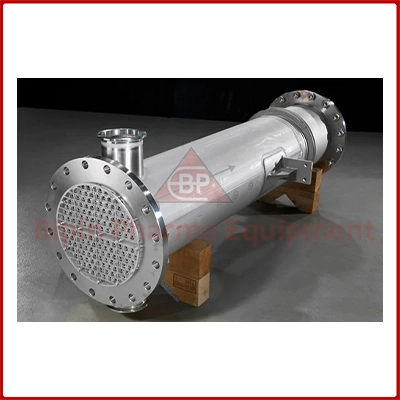
The Shell & Tube Condenser consists of a cylindrical shell (outer pressure vessel) through which a bundle of tubes is installed. The tube bundle typically consists of multiple parallel tubes (ranging from a few dozen to several hundred depending on the condenser size) fixed at both ends in tube sheets. Process vapour flows through the tube side (inside the tubes), and cooling water flows through the shell side (outside the tubes but inside the cylindrical shell) in counter-current or cross-flow arrangement. Heat is transferred from the hot vapour inside the tubes through the tube walls to the cooling water on the shell side, condensing the vapour to liquid.
Working Principle
Process vapour enters the tube side through the top inlet header, flows downward through the parallel tubes, loses heat to the cooling water on the shell side, and exits as liquid condensate from the bottom tube-side outlet. Cooling water enters the shell side from the bottom (counter-current to vapour flow for maximum temperature driving force) and exits from the top. Non-condensable gases (nitrogen, air) exit through a vent at the top of the tube side, preventing gas binding that would reduce condenser efficiency.
Key Features of Shell & Tube Condenser
- High heat transfer efficiency — counter-current flow maximises temperature driving force (LMTD)
- SS316L tubes and tube sheets with SS304 or SS316L shell
- Available in a wide range of heat transfer areas — from 0.5 m² to over 50 m²
- Fixed tube sheet or U-tube configuration depending on thermal expansion requirements
- TEMA standard design (B, C, or R class) for pressure vessel code compliance
- Suitable for high vapour loads and large reactor systems (500 L to 50,000 L reactors)
- Baffles on shell side improve cooling water distribution and heat transfer coefficient
- Vent and drain connections on both tube side and shell side
- Pressure rated for both tube side and shell side independently
- Hydrostatic pressure testing required on both sides before commissioning
Best Applications of Shell & Tube Condenser
- Large pharmaceutical API synthesis reactors (500 L to 50,000 L capacity)
- High vapour load operations — fast-boiling reflux reactions and rapid distillations
- Vacuum distillation systems requiring high vapour condensation rates
- Multi-column distillation plant condensers in sterile water systems
- Solvent recovery systems requiring maximum condensation efficiency
- High-temperature vapour condensation (above 100°C vapour inlet temperature)
- Systems requiring easy tube bundle removal for cleaning or replacement
2. Box Type Condenser: Construction, Working Principle & Features
Construction
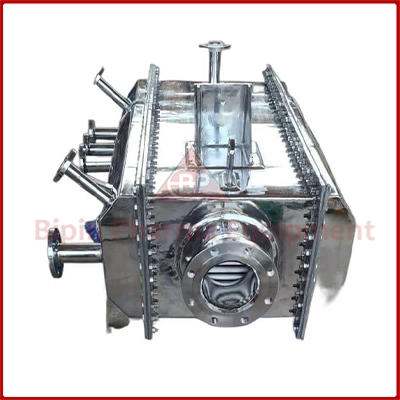
The Box Type Condenser has a fundamentally different geometry from the Shell & Tube Condenser. Instead of a cylindrical shell, it uses a rectangular box-shaped outer housing (the shell side). Inside this rectangular box, a bundle of straight tubes is installed, with their ends fixed in rectangular tube sheets. Cooling water fills the rectangular box (shell side) and surrounds the tubes, while process vapour flows through the tubes. The rectangular design gives the Box Type Condenser its characteristic compact, space-efficient footprint.
Working Principle
Process vapour enters the tube side through the top inlet, flows through the parallel tube bundle, loses heat to the cooling water surrounding the tubes on the box (shell) side, and exits as liquid condensate from the bottom. Cooling water enters the box from one side and exits from the opposite side. The heat transfer mechanism is the same as in the Shell & Tube Condenser — conduction through tube walls — but the geometry and flow characteristics differ due to the rectangular shell design.
Key Features of Box Type Condenser
- Compact rectangular design for space-efficient, easy installation
- Lower capital cost compared to Shell & Tube Condenser of equivalent duty
- SS316L tube bundle in SS304 or MS (mild steel) rectangular box shell
- Suitable for moderate vapour loads and small to medium reactor systems (50 L to 5,000 L)
- Simple construction — fewer components; easier to fabricate and maintain
- Horizontal or vertical installation options available
- Drain and vent connections on tube side and shell side
- Available in a range of sizes matched to standard reactor capacities
- Lower cooling water pressure drop on shell side compared to baffled shell & tube design
Best Applications of Box Type Condenser
- Small to medium pharmaceutical reactors (50 L to 5,000 L capacity)
- Moderate vapour load applications — standard reflux and atmospheric distillation
- Pilot plant and R&D reactor installations where space is limited
- Cost-sensitive applications where condenser duty does not justify Shell & Tube cost
- Installations requiring horizontal condenser mounting
- Chemical synthesis plants with space-constrained equipment layouts
Shell & Tube Condenser vs Box Type Condenser: Complete Comparison
| Parameter | Shell & Tube Condenser | Box Type Condenser |
|---|---|---|
| Shell geometry | Cylindrical (circular cross-section) | Rectangular box (rectangular cross-section) |
| Tube arrangement | Circular bundle with baffles on shell side | Rectangular bundle; no baffles required |
| Heat transfer area | Large — 0.5 m² to 50+ m² | Moderate — 0.1 m² to 10 m² |
| Heat transfer efficiency | Higher — counter-current flow with baffles increases LMTD and HTC | Moderate — simpler cross-flow arrangement |
| Vapour load capacity | High — suitable for large, fast-reflux operations | Moderate — suitable for standard batch operations |
| Reactor size suitability | 500 L to 50,000 L reactors | 50 L to 5,000 L reactors |
| Capital cost | Higher (complex cylindrical shell design) | Lower (simpler rectangular fabrication) |
| Physical footprint | Larger — cylindrical shell with support saddles | Compact — fits in confined spaces |
| Pressure rating | Full pressure rating on both tube and shell sides independently | Moderate pressure rating; suitable for atmospheric and moderate vacuum |
| Tube bundle removal | Yes — removable tube bundle for mechanical cleaning | Limited — fixed tube bundle in most designs |
| Shell side cleaning | Easy — hydrojetting or chemical cleaning through shell nozzles | Moderate — drain and flush through shell connections |
| Standards compliance | TEMA / ASME Section VIII | General engineering standards; not TEMA-rated typically |
| Preferred for | Large-scale commercial API synthesis; high duty applications | Pilot, small commercial, cost-sensitive applications |
How Condensers Integrate with the Reactor and Receiver
Neither the Shell & Tube Condenser nor the Box Type Condenser operates in isolation — both work as part of an integrated reactor system that includes the upstream SS Reactor and the downstream Receiver. The three pieces of equipment form a closed vapour management system:
| Operation Mode | Reactor Role | Condenser Role | Receiver Role |
|---|---|---|---|
| Total reflux | Generates solvent vapour; reflux maintains solvent level | Condenses 100% of vapour; returns all condensate to reactor | Not active (reflux valve fully open to reactor) |
| Partial reflux distillation | Generates vapour; some returned, some collected | Condenses all vapour; reflux valve controls split | Collects distillate fraction; volume measured |
| Total distillation (solvent removal) | Heats reaction mass; all solvent evaporated | Condenses 100% of solvent vapour to distillate | Collects all distillate; confirms endpoint by volume |
| Vacuum distillation | Under vacuum; low-temperature evaporation | Condenses vacuum vapour; acts as liquid seal for vacuum pump protection | Collects vacuum distillate; liquid buffer for vacuum pump |
| Solvent swap | Old solvent removed by distillation; new solvent added | Condenses old solvent to distillate | Collects old solvent; volume tracking confirms completion |
Condenser Sizing Guide for Pharmaceutical Reactors
Correct condenser sizing is critical for efficient reactor operation. An undersized condenser cannot handle the vapour load during reflux or distillation, leading to vapour breakthrough and solvent loss. An oversized condenser wastes capital cost and increases cooling water consumption. Key sizing parameters include:
| Reactor Capacity | Recommended Condenser Type | Approximate Heat Transfer Area | Cooling Water Flow (approx.) |
|---|---|---|---|
| 50–200 L reactor | Box Type Condenser | 0.1–0.5 m² | 100–300 LPH |
| 200–500 L reactor | Box Type Condenser | 0.5–1.5 m² | 300–800 LPH |
| 500–1,000 L reactor | Box Type or Shell & Tube | 1.5–3.0 m² | 800–2,000 LPH |
| 1,000–5,000 L reactor | Shell & Tube Condenser | 3.0–15 m² | 2,000–10,000 LPH |
| 5,000–20,000 L reactor | Shell & Tube Condenser | 15–50 m² | 10,000–40,000 LPH |
Note: Actual condenser sizing must be based on thermal calculations using the specific heat of vaporisation of the solvent, vapour generation rate, inlet/outlet temperatures, and cooling water temperature. These values are specific to each process — the above table provides approximate guidance only.
Condenser Selection Framework: When to Choose Which
| If your situation is... | Choose this condenser |
|---|---|
| Large commercial reactor (1,000 L and above) | Shell & Tube Condenser |
| High vapour load operation (fast-boiling reflux, large-scale distillation) | Shell & Tube Condenser |
| Maximum condensation efficiency required (high duty) | Shell & Tube Condenser |
| Multi-column distillation plant (WFI / PW generation) | Shell & Tube Condenser |
| High-temperature vapour condensation (above 100°C) | Shell & Tube Condenser |
| Tube bundle cleaning or replacement required (fouling service) | Shell & Tube Condenser |
| Small to medium reactor (50 L to 1,000 L) | Box Type Condenser |
| Pilot plant or R&D reactor installation | Box Type Condenser |
| Space-constrained installation (compact condenser required) | Box Type Condenser |
| Cost-sensitive project; moderate vapour load only | Box Type Condenser |
| Standard atmospheric reflux distillation; moderate duty | Box Type Condenser |
GMP and Engineering Requirements for Pharmaceutical Condensers
- All product-contact surfaces (tube side carrying process vapour and condensate) must be SS316L with Ra ≤ 0.8 µm surface finish
- Shell side (cooling water) may be SS304 or SS316L; avoid carbon steel in pharmaceutical environments to prevent rust contamination of cooling water
- All welds on product-contact surfaces must be full-penetration butt welds, pickled and passivated
- Tube-to-tube-sheet joints must be roller expanded and seal-welded to prevent cross-contamination between tube side and shell side
- Pressure testing (hydrostatic) on both tube side and shell side required before commissioning; test certificates must be maintained
- Material test certificates (MTCs) for SS316L tubes, tube sheets, and shell required for GMP documentation
- Vent and drain connections must be provided on both sides for complete drainability
- Insulation of hot sections required for ATEX safety and energy efficiency in flammable solvent applications
- All condensers used in flammable solvent service must have ATEX-compliant earthing and bonding provisions
- IQ, OQ documentation required for condensers used in GMP API manufacturing; PQ demonstrates condensation efficiency meets process requirements
Frequently Asked Questions (FAQ)
Conclusion
Both the Shell & Tube Condenser and the Box Type Condenser are well-established, GMP-compliant solutions for pharmaceutical reactor vapour management — but they serve different capacity ranges, duty levels, and installation contexts. The Shell & Tube Condenser offers superior heat transfer efficiency, higher vapour load capacity, and greater scalability for large commercial reactor systems. The Box Type Condenser provides a compact, cost-effective solution for pilot, R&D, and small to medium commercial reactor installations.
The right condenser choice, combined with the correctly sized Receiver and integrated with the SS Reactor, ensures safe, efficient, and GMP-compliant vapour management across all reactor operations — reflux, distillation, solvent swap, and vacuum processing.
We manufacture and export Shell & Tube Condensers, Box Type Condensers, and Receivers to GMP and pressure vessel standards for pharmaceutical API and chemical manufacturers across India and internationally.
Enquire About Our Condenser & Reactor Systems
Speak with our technical team for expert guidance on condenser selection, sizing, and reactor system configuration.
Send Enquiry Contact Us