Stainless Steel Reactors in Pharma: Types, Uses & Selection Guide
The stainless steel reactor is the central, defining piece of equipment in pharmaceutical API synthesis and chemical manufacturing. Every reaction step — from condensation and esterification to hydrogenation, crystallisation, and distillation — takes place inside the reactor vessel. The design, material of construction, agitation system, jacket configuration, and associated equipment of the reactor directly determine product quality, reaction yield, process safety, and regulatory compliance.
This comprehensive guide covers pharmaceutical stainless steel reactors in depth — including reactor types, working principles, key components, agitation systems, condenser and receiver integration, process parameters, material selection, and GMP requirements — to help manufacturers make informed decisions when specifying reactor systems.
We are a leading manufacturer, supplier, and exporter of Stainless Steel Reactors, Shell & Tube Condensers, Box Type Condensers, and Receivers for pharmaceutical API and chemical manufacturers in India and worldwide.
The Role of the Reactor in Pharmaceutical Manufacturing
In pharmaceutical API synthesis and chemical manufacturing, the reactor is where the core chemistry happens. Raw materials (starting materials, reagents, solvents) are charged into the reactor vessel, reaction conditions (temperature, pressure, agitation, pH) are applied, and the product — the API or chemical intermediate — is formed through controlled chemical reactions.
The reactor must provide:
- Precise temperature control — heating and cooling — for reaction initiation, progression, and quenching
- Efficient mixing of all reactants for uniform concentration and reaction rate throughout the vessel
- Pressure control capability for reactions that require elevated or reduced pressure conditions
- Vapour management through connected condenser systems for reflux, solvent recovery, and distillation
- Safe containment of hazardous, flammable, or toxic reagents and solvents under ATEX-rated conditions
- Clean, inert product-contact surfaces that do not catalyse unwanted side reactions or leach contaminants into the product
Types of Stainless Steel Reactors Used in Pharma
1. Jacketed Stirred Tank Reactor (JSTR)
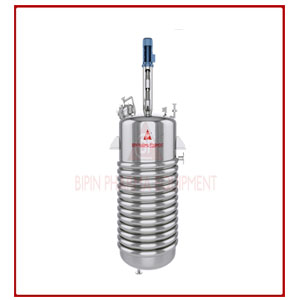
The Jacketed Stirred Tank Reactor is by far the most common reactor type in pharmaceutical API synthesis. It consists of a cylindrical SS316L vessel with a heating/cooling jacket and an internal agitator. The jacket allows independent temperature control of the reaction mass by circulating heating or cooling media (steam, hot water, thermic fluid, chilled water, or brine). The agitator ensures uniform mixing of reactants, uniform temperature distribution, and prevents solid settling in suspension reactions.
The SS Reactor from our range is a GMP-compliant jacketed stirred tank reactor available in a wide range of capacities and configurations for pharmaceutical and chemical synthesis applications.
2. Pressure Reactor
Pressure reactors are designed to safely operate at above-atmospheric pressures — typically used for hydrogenation, high-temperature reactions, and reactions requiring pressurised gas reactants (hydrogen, nitrogen, carbon dioxide). They feature thick-walled vessel construction, pressure-rated head connections, safety relief valves, and burst disc protection. All pressure-containing components must be designed and certified per ASME Section VIII or equivalent pressure vessel codes.
3. Vacuum Reactor
Vacuum reactors operate under sub-atmospheric pressure — used for reactions and distillations that require low-temperature processing to protect heat-sensitive intermediates, to achieve reflux at lower temperatures, or to facilitate solvent removal under vacuum. They feature vacuum-rated construction, vacuum-sealed agitator entries, and connections to condenser and vacuum pump systems.
4. High-Shear Reactor
High-shear reactors are fitted with high-speed rotor-stator mixers or high-shear impellers rather than conventional low-speed agitators. They are used for reactions requiring rapid, intense mixing — such as emulsification reactions, dispersion of immiscible liquids, or reactions with mass transfer limitations. The Colloid Mill may also be used inline with the reactor for continuous high-shear processing of viscous reaction masses.
5. Glass-Lined Reactor
Glass-lined reactors have a smooth borosilicate glass lining fused to the inner surface of a carbon steel vessel. They are used for highly acidic or highly corrosive reactions where SS316L would be attacked — such as HCl-mediated reactions, strong acid synthesis, and reactions with chlorinated solvents. While GMP-compliant in their application domain, glass-lined reactors are more fragile and difficult to clean than SS reactors and are not preferred for GMP pharmaceutical applications unless chemically necessary.
Key Components of a Pharmaceutical SS Reactor System
| Component | Function | Key Specification |
|---|---|---|
| Reactor vessel (shell) | Contains the reaction mass; primary process vessel | SS316L, pressure/vacuum rated, DIN/ASME standard |
| Heating/cooling jacket | Provides temperature control of reaction mass via circulating heating/cooling media | Full jacket, half-pipe jacket, or limpet coil; rated for utility pressure |
| Agitator assembly | Mixes reactants; ensures uniform temperature and concentration; prevents settling | Anchor, turbine, paddle, or propeller type; variable speed drive |
| Agitator seal | Prevents vapour leakage at agitator shaft entry point; maintains vessel pressure/vacuum | Mechanical seal (single/double); magnetic coupling for complete containment |
| Top head (dish end) | Vessel closure with all process connections — charge inlets, vent, manway, instruments | Dished (torispherical or hemispherical) head; SS316L; pressure rated |
| Bottom outlet valve | Controlled discharge of reaction mass to downstream equipment | Full-bore bottom valve; flush-mounted; SS316L |
| Shell & Tube Condenser or Box Type Condenser | Condenses solvent vapours during reflux, distillation, or vacuum operations; returns condensate to reactor or collects in receiver | SS316L tubes and shell; cooling water on shell side; sized for vapour load |
| Receiver | Collects condensed solvent / distillate from condenser; measures collected volume; feeds back to reactor or sends to solvent recovery | SS316L; pressure/vacuum rated; sight glass; calibrated |
| Safety relief valve | Protects vessel from overpressure; opens at set pressure to vent safely | ASME/PED rated; set pressure per vessel design pressure |
| Rupture disc (burst disc) | Secondary overpressure protection; provides instantaneous full-bore vent in case of catastrophic overpressure | Rated for vessel design pressure; SS316L or Inconel |
| Instrumentation | Temperature (RTD/thermocouple), pressure (gauge/transducer), level (sight glass/level transmitter), pH (in-line probe) | Calibrated instruments; 21 CFR Part 11 compliant data logging |
Agitator Types for Pharmaceutical Reactors
The agitator is one of the most critical design elements of a pharmaceutical reactor — it determines mixing efficiency, heat transfer performance, reaction uniformity, and product quality. The correct agitator type depends on the viscosity of the reaction mass, the required mixing intensity, and whether solids are present in the reaction:
| Agitator Type | Best For | Characteristics |
|---|---|---|
| Anchor agitator | Viscous liquids, wall-scraped heat transfer | Sweeps vessel walls; excellent heat transfer; low shear; slow speed (10–60 RPM) |
| Turbine agitator | Low to medium viscosity reactions; dispersing gases | High radial flow; good mixing; moderate shear; medium speed |
| Paddle agitator | Gentle mixing of settled solids; crystallisation | Low shear; prevents crystal breakage; used in crystallisation reactors |
| Propeller agitator | Low-viscosity liquids requiring high flow rates | Axial flow; high turnover; good for homogeneous reactions |
| Retreat curve impeller (RCI) | Moderate viscosity; heat-sensitive reactions | Gentle mixing; minimal shear; good wall sweeping; common in API synthesis |
| Gate / Frame agitator | Highly viscous pastes and slurries | Heavy-duty construction; high torque drive; slow speed; for dense, viscous masses |
Condensers Used with Pharmaceutical Reactors
Every pharmaceutical reactor system requires a condenser to manage the vapour phase generated during heating, reflux, distillation, and vacuum operations. Two types of condensers are used:
Shell & Tube Condenser
The Shell & Tube Condenser is the most widely used condenser type in pharmaceutical reactor systems. It consists of a bundle of SS316L tubes enclosed within a cylindrical shell. The process vapour (solvent, reactant) flows through the tube side, and cooling water flows counter-currently through the shell side. Heat is transferred from the hot vapour to the cooling water through the tube walls, condensing the vapour back to liquid. Shell & Tube Condensers offer high heat transfer efficiency, are easy to clean, and are available in a wide range of surface areas for different vapour loads.
Key Features of Shell & Tube Condenser
- SS316L tubes and tube sheets; SS304 or SS316L shell
- Counter-current flow design for maximum condensation efficiency
- Available heat transfer areas from 0.5 m² to 50 m²
- Fixed tube sheet or U-tube design depending on thermal expansion requirements
- Pressure rated to suit process and utility pressures
- TEMA (Tubular Exchanger Manufacturers Association) standard design
- Vent connection for non-condensable gas separation
- Drain connection for complete condensate recovery
Box Type Condenser
The Box Type Condenser is a compact, rectangular condenser design where the process vapour flows through SS316L tubes arranged within a rectangular box-shaped shell. Cooling water fills and circulates through the box (shell side). The Box Type Condenser is typically used where installation space is limited, where a compact, lower-cost condenser is sufficient, or where the vapour load is moderate. It is popular in small to medium capacity reactor systems in pharmaceutical synthesis and chemical plants.
Key Features of Box Type Condenser
- Compact rectangular design for space-efficient installation
- SS316L tube bundle in SS304 or MS box shell
- Suitable for moderate vapour loads and cooling requirements
- Lower capital cost compared to shell & tube condensers
- Easy installation and maintenance
- Available in a range of sizes to suit reactor capacities from 50 L to 5,000 L
- Drain and vent connections included
The Receiver: Collecting and Managing Condensate
The Receiver is a critical auxiliary vessel in pharmaceutical reactor systems. It is connected to the outlet of the condenser and collects the condensed solvent, distillate, or reaction by-product that exits the condenser. The Receiver serves multiple functions in pharmaceutical and chemical manufacturing:
- Distillate collection: During solvent distillation or solvent swap operations, the Receiver collects the distillate for volume measurement and disposal or recycling
- Reflux control: In reflux operations, the Receiver holds condensed solvent temporarily before returning it to the reactor via a reflux valve — maintaining the required solvent level in the reactor
- Solvent recovery: The Receiver acts as the primary solvent recovery vessel — collected solvents are measured, assessed for purity, and either recycled directly or sent to solvent recovery/redistillation
- Vacuum buffer: In vacuum reactor systems, the Receiver provides a liquid buffer that protects the vacuum pump from liquid carry-over
Key Features of Receiver
- SS316L stainless steel construction throughout
- Pressure and vacuum rated (FV to 3.5 bar or higher)
- Calibrated sight glass for accurate volume measurement
- Inlet from condenser; outlet to reactor (reflux) or solvent recovery
- Vent connection with flame arrestor for flammable solvent applications
- ATEX-rated design available for flammable solvent environments
- Available in capacities from 25 L to 2,000 L
- Optional: load cells for gravimetric measurement; heating jacket for viscous condensates
How the Reactor, Condenser, and Receiver Work Together
The pharmaceutical reactor, condenser, and receiver function as an integrated system. Understanding how they interact is essential for designing an efficient, safe, and GMP-compliant reactor train:
| Operation | Reactor Role | Condenser Role | Receiver Role |
|---|---|---|---|
| Reaction under reflux | Contains reaction mass; jacket heats to reflux temperature; vapour rises from boiling solvent | Condenses solvent vapour back to liquid; returns condensate via reflux line | Holds excess condensate; controls reflux ratio via valve |
| Solvent distillation / removal | Jacket heats reaction mass; solvent evaporates from product | Condenses solvent vapour from reactor to liquid | Collects distillate; measures volume; solvent recovery or disposal |
| Vacuum distillation | Operates under vacuum; solvent evaporates at reduced temperature | Condenses vacuum solvent vapour; prevents vapour reaching vacuum pump | Collects vacuum distillate; acts as liquid buffer for vacuum pump protection |
| Solvent swap | Old solvent distilled off under heat/vacuum; new solvent added | Condenses old solvent for collection | Collects old solvent for volume tracking; confirms distillation completion |
| Crystallisation | Reaction mass cooled in jacket; product crystallises from solution | May not be active; condenser on standby | Receiver may collect any residual vapour condensate during cooling |
Material of Construction Selection for Pharmaceutical Reactors
| Material | Properties | Recommended When |
|---|---|---|
| SS316L | Excellent corrosion resistance; low carbon prevents sensitisation; GMP standard | Most pharmaceutical API synthesis; standard organic solvent applications |
| SS304 | Good corrosion resistance; lower molybdenum content than 316L | Less aggressive applications; non-halogenated solvents; utility equipment |
| Hastelloy C-276 | Superior resistance to chloride, oxidising acids, and aggressive chemicals | HCl-mediated reactions; chlorinated solvent reactions; highly acidic conditions |
| Titanium | Excellent corrosion resistance to chlorides and oxidising acids; lighter than SS | Strongly acidic and oxidising environments; HF applications |
| Inconel 600/625 | High temperature and corrosion resistance; excellent in alkaline conditions | High-temperature reactions; strongly alkaline conditions |
| Glass-lined (CS + glass) | Chemically inert lining; excellent for strong acids | Strong acid reactions (H₂SO₄, HNO₃, HCl); pharmaceutical API synthesis where SS would be attacked |
Critical Process Parameters in Pharmaceutical Reactor Operations
| Parameter | Typical Range | Why It Matters |
|---|---|---|
| Reaction temperature | -20°C to +250°C (reaction-specific) | Controls reaction rate, selectivity, yield, and API purity |
| Jacket temperature | Utility-dependent (brine to steam) | Drives heating / cooling of reaction mass; must respond rapidly to temperature changes |
| Agitator speed | 20–200 RPM (reaction-specific) | Affects mixing uniformity, mass transfer, heat transfer, and crystal size distribution |
| Operating pressure | Full vacuum (FV) to 10 bar (reaction-specific) | Affects boiling point of solvents; controls reflux; enables pressure reactions |
| pH | 1–14 (reaction-specific) | Controls reaction selectivity, API salt formation, and crystallisation |
| Charge rate of reactants | Controlled addition (hours for exothermic reactions) | Controls heat release rate; prevents runaway exothermic reactions |
| Condenser cooling water temperature | 10–25°C (inlet) | Determines condenser efficiency; lower temp = better vapour condensation |
| Reaction time | Batch-specific (minutes to days) | Determines yield and purity; must be validated per IPC sampling results |
SS Reactor Selection Framework
| Selection Criterion | Consideration | Impact on Reactor Design |
|---|---|---|
| Reaction chemistry | Acid/base conditions, oxidising/reducing environment, solvent type | Determines material of construction (SS316L, Hastelloy, glass-lined) |
| Temperature range | Reaction temperature extremes; cryogenic vs high-temperature | Determines jacket type (steam, thermic fluid, brine, glycol) |
| Pressure requirement | Atmospheric, vacuum, elevated pressure | Determines vessel wall thickness, pressure rating, head design |
| Viscosity of reaction mass | Low viscosity solution vs high-viscosity paste | Determines agitator type, power, and speed |
| Exothermic / endothermic nature | Heat generation rate; cooling demand | Determines jacket area, utility flow rates, and safety systems |
| Batch volume | Scale of production (pilot to commercial) | Determines reactor capacity (litres); agitator sizing |
| Solvent management | Reflux, distillation, solvent swap | Determines condenser type and area; receiver capacity |
| Hazard classification | Flammable solvents; toxic reactants; HPAPI | Determines ATEX rating, containment design, vent scrubbing |
GMP Requirements for Pharmaceutical Reactor Systems
- All product-contact surfaces must be SS316L (or specified alloy) with Ra ≤ 0.8 µm finish; electropolished Ra ≤ 0.4 µm for highly sensitive applications
- Reactor vessel must be designed and fabricated per applicable pressure vessel code (ASME Section VIII, PED, IBR) with third-party inspection and certification
- Safety relief valve and rupture disc must be fitted, rated, tested, and documented; relief device inspection schedule must be validated
- All pressure-retaining joints must be full-penetration butt welds with radiographic examination certification
- Agitator mechanical seal must be validated for zero-leakage under both positive pressure and vacuum conditions
- All instruments (temperature, pressure, level, pH) must be calibrated on a validated schedule with calibration certificates maintained
- Reactor system must be ATEX Zone 1 certified for all electrical components when used with flammable solvents
- Nitrogen inerting system must be validated for O₂ content below flammable limit (typically <2% v/v)
- Cleaning procedure must be validated for all product-contact surfaces; TOC or rinse water sampling to confirm cleaning effectiveness
- IQ, OQ, and PQ validation documentation required; PQ must demonstrate consistent product yield and purity across minimum 3 consecutive batches
Frequently Asked Questions (FAQ)
Conclusion
The stainless steel reactor is the heart of pharmaceutical API synthesis — and its design, material selection, agitator configuration, and integration with condenser and receiver systems determines the quality, yield, safety, and regulatory compliance of every API batch it produces. Selecting the right reactor system requires a thorough analysis of reaction chemistry, temperature range, pressure requirements, solvent management needs, and hazard classification.
Our complete chemical reactor range — SS Reactor, Shell & Tube Condenser, Box Type Condenser, and Receiver — is manufactured to GMP and pressure vessel standards and available for pharmaceutical API, chemical, and specialty chemical manufacturers across India and internationally. All systems are supplied with full material traceability, pressure test certificates, and validation documentation.
Enquire About Our Stainless Steel Reactor Systems
Speak with our technical team for expert guidance on reactor design, capacity, material selection, and pricing.
Send Enquiry Contact Us