Terms & Conditions Privacy Policy Disclaimer

Types of Filter Presses Used in Pharma: Complete Comparison Guide

Filtration is a critical unit operation in pharmaceutical manufacturing. Whether clarifying a syrup, separating a crystallised API from a reaction solvent, or removing residual moisture from a filter cake, the right filtration equipment determines product quality, yield, process efficiency, and regulatory compliance. Filter presses are the most widely used pressure-driven filtration devices in pharmaceutical production — but different types of filter presses serve very different purposes.

This guide provides a complete comparison of the three main types of filter presses used in pharmaceutical manufacturing — the Zero Hold Up Filter Press, the Sparkler Filter Press, and the Agitated Nutsche Filter Dryer (ANFD) — covering working principles, construction, key features, applications, and a practical selection framework.

We are a leading manufacturer, supplier, and exporter of all three types of pharmaceutical filtration equipment for API manufacturers, formulation plants, and chemical process industries in India and worldwide.

Why Filtration is Critical in Pharmaceutical Manufacturing

Filtration serves multiple essential functions across different segments of pharmaceutical manufacturing:

  • Removing undissolved particles and filter cake from pharmaceutical liquids — syrups, solutions, and APIs in solvent
  • Separating crystallised or precipitated API solid from the mother liquor after reaction or crystallisation
  • Clarifying oral liquid formulations to meet pharmacopoeial visible particulate standards
  • Washing filter cakes with fresh solvent to remove impurities and reduce residual solvent levels
  • Drying filter cakes under vacuum to meet LOD and residual solvent specifications
  • Preventing microbial contamination in liquid pharmaceutical products through particle removal
  • Recovering maximum product yield from batch filtration operations

Selecting the correct filter press type for each application is essential — using the wrong filtration equipment leads to poor product quality, low yield, extended cycle times, and GMP compliance failures.

Overview: Three Types of Filter Presses in Pharma

Filter Press TypePrimary FunctionOperating PrincipleKey Application
Zero Hold Up Filter PressLiquid filtration with maximum product recoveryPressure-driven through filter plates; zero dead volume designOral liquid / syrup filtration; high-value API solutions
Sparkler Filter PressBulk clarification and polishing of liquidsPressure-driven through horizontal leaf stack; can use filter aidSyrup clarification; solution polishing; API in solvent
Agitated Nutsche Filter Dryer (ANFD)Solid-liquid separation + cake washing + drying in one vesselPressure / vacuum filtration with agitator; vacuum drying under jacket heatingAPI isolation from reaction; filter cake washing and drying

1. Zero Hold Up Filter Press

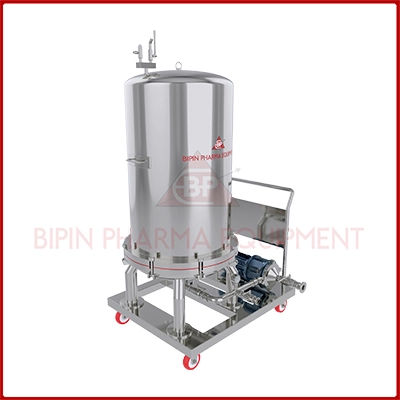
The Zero Hold Up Filter Press is a pressure-driven plate filter designed specifically to achieve maximum product recovery in pharmaceutical liquid filtration. Its defining characteristic — from which it derives its name — is the zero dead volume design: after filtration is complete, virtually no product is retained inside the filter housing. This makes it the preferred filtration solution for high-value pharmaceutical formulations where every drop of product matters.

How the Zero Hold Up Filter Press Works

The liquid to be filtered is pumped under pressure into the filter housing, which contains a stack of circular filter plates fitted with filter media (filter paper, polypropylene filter cloth, or membrane). As the liquid passes through the filter media under pressure, particulates are retained on the filter surface and the clarified filtrate passes through. When filtration is complete, the filter housing is blown out with compressed nitrogen or air, pushing all remaining liquid through the filter and into the collection vessel — leaving essentially zero product hold-up in the filter.

Key Features of Zero Hold Up Filter Press

  • Zero dead volume design — virtually complete product recovery after filtration cycle
  • SS316L stainless steel construction for all product-contact parts
  • Mirror-polished internal surfaces for easy cleaning and validation
  • Circular filter plates in polypropylene or SS316L mesh for various filtration grades
  • Operating pressure up to 5 bar for efficient filtration of viscous products
  • Compact, fully closed design prevents product contamination during filtration
  • Easy plate disassembly for cleaning and filter media replacement
  • CIP (Clean-in-Place) compatible design for validated automated cleaning
  • Available for batch volumes from 50 L to 5,000 L
  • Suitable for aqueous solutions, syrups, hydroalcoholic preparations, and APIs in solvent

Best Applications of Zero Hold Up Filter Press

  • Filtration of high-value oral liquid formulations — antibiotic syrups, specialty vitamins, hormone solutions
  • Final polishing filtration of pharmaceutical syrups before filling
  • Filtration of injectable-grade solutions where product loss must be minimised
  • API solutions in organic solvents where complete solvent recovery is required
  • Small-batch specialty formulations where yield is commercially critical
  • Multi-product plants requiring rapid changeover and validated cleaning

2. Sparkler Filter Press

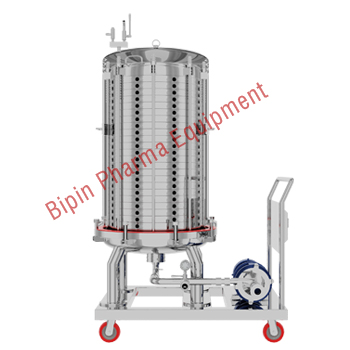
The Sparkler Filter Press is a horizontal leaf pressure filter that is the workhorse of pharmaceutical liquid clarification. It uses a stack of circular, horizontal filter leaves inside a pressure vessel — with the product flowing upward through the leaf stack under applied pressure. The Sparkler Filter Press is particularly effective when used with filter aid materials (such as Diatomaceous Earth or Perlite), which form a precoat on the filter leaves and dramatically improve clarification efficiency for turbid liquids.

How the Sparkler Filter Press Works

The liquid enters the bottom of the vertical cylindrical housing and flows upward through a stack of horizontal circular filter leaves. Each leaf is covered with a SS316L mesh over which filter paper or a filter cloth is placed. Particles are retained on the filter media surface, building up a filter cake, while the clarified filtrate passes through into an internal central filtrate collector and exits through the outlet. When the filter cake is fully loaded, the housing is drained, the filter leaves are removed, and the cake is discharged. The housing and leaves are then cleaned before the next filtration cycle.

Key Features of Sparkler Filter Press

  • Horizontal leaf filter design for efficient cake formation and superior clarification
  • SS316L stainless steel housing and filter leaves throughout
  • Multiple filter leaf configurations — available in 7, 10, 13, 17, 21, and 25 filter leaves
  • Filter areas from 0.1 m² to over 2.5 m² to suit batch volumes from 50 L to 20,000 L
  • Compatible with Diatomaceous Earth (DE) precoat for deep bed filtration
  • Pressure-rated to 5 bar for handling viscous syrups and dense liquids
  • Top-opening design for easy access to filter leaves for cleaning and maintenance
  • GMP-compliant design with minimal dead volume and complete drainability
  • Available with heating jacket for temperature-sensitive filtration applications
  • Suitable for syrups, oral solutions, APIs in solvent, herbal extracts, and chemical intermediates

Best Applications of Sparkler Filter Press

  • Primary clarification of pharmaceutical syrups and oral liquid formulations
  • Polishing and clarification of APIs dissolved in organic solvents after reaction
  • Filtration of herbal extracts and botanical preparations
  • Removal of activated carbon from decolourisation treatments
  • Clarification of fermentation broths and vitamin solutions
  • Chemical intermediate filtration in API synthesis plants
  • Large-volume batch filtration where throughput is the priority

3. Agitated Nutsche Filter Dryer (ANFD)

The Agitated Nutsche Filter Dryer (ANFD) is fundamentally different from both the Zero Hold Up Filter Press and the Sparkler Filter Press. Rather than clarifying a liquid, the ANFD is designed to separate solid API or chemical particles from a liquid phase (filtration), wash the resulting filter cake with fresh solvent to remove impurities (cake washing), and then dry the washed cake to a validated moisture or residual solvent specification (cake drying) — all within a single, sealed, contained vessel without any product transfer steps.

How the Agitated Nutsche Filter Dryer Works

The slurry from the upstream reactor is charged into the ANFD vessel through the top inlet. Filtration is accomplished by applying pressure from the top (or vacuum from below) to force the liquid through the filter plate at the base of the vessel. The solid cake is retained on the filter plate. An agitator arm with adjustable blade angle moves across the filter plate to delump the cake, promote uniform cake formation, and assist in cake washing. After washing, the jacket is heated and vacuum is applied to dry the cake. The dried API is discharged through a bottom discharge valve without any exposure to atmosphere.

Key Features of Agitated Nutsche Filter Dryer (ANFD)

  • Combines filtration, cake washing, and vacuum drying in a single contained vessel
  • SS316L stainless steel construction with Hastelloy or other exotic alloys available for corrosive applications
  • Jacketed vessel for heating (steam/hot water) and cooling (chilled water) during drying and temperature control
  • Agitator with variable speed and tilt angle for optimal cake delumping and washing efficiency
  • Vacuum capability for low-temperature drying to protect heat-sensitive APIs
  • Solvent recovery capability through condenser connection — essential for ICH Q3C compliance
  • Fully closed, contained design — ideal for highly potent APIs (HPAPI) requiring operator protection
  • CIP/SIP (Sterilise-in-Place) compatible designs available for sterile API applications
  • Available in capacities from 0.1 m² to over 10 m² filter area
  • ATEX-certified designs available for flammable solvent applications

Best Applications of ANFD

  • API isolation and purification after chemical synthesis and crystallisation
  • Processing of highly potent APIs where complete containment is mandatory
  • Cake washing to remove impurities and reduce residual solvent levels to ICH Q3C limits
  • Vacuum drying of heat-sensitive API filter cakes at temperatures below 50°C
  • Multi-step processing (filter + wash + dry) without any product transfer
  • Processing of oxygen-sensitive APIs under nitrogen blanket
  • Chemical synthesis applications with flammable or toxic solvents (ATEX design)

Complete Comparison: Zero Hold Up vs Sparkler vs ANFD

ParameterZero Hold Up Filter PressSparkler Filter PressANFD (Nutsche Filter Dryer)
Primary functionLiquid clarification (max yield)Bulk liquid clarificationSolid-liquid separation + cake wash + drying
Product form processedLiquid (solution / syrup)Liquid (solution / syrup)Slurry / suspension with solids
Product recoveryVirtually 100% (zero hold-up)Good (small residual in filter)Excellent for solids; mother liquor discharged
Cake washing capabilityNoNoYes — multi-stage washing possible
Drying capabilityNoNoYes — vacuum drying with jacket heating
Use of filter aid (DE)NoYes — DE precoat commonly usedNo
Containment (HPAPI)Good (closed system)Moderate (top access required)Excellent (fully sealed, closed)
Solvent recoveryLimitedLimitedYes — with condenser connection
Viscous liquid handlingGoodExcellent (DE precoat helps)N/A — slurry not viscous liquid
Cleaning / CIPEasy — full CIP compatibleManual leaf cleaning; CIP housingCIP/SIP compatible; automated cleaning available
Capital costModerateModerateHigh (multi-function vessel)
Typical industryFormulation / oral liquidsFormulation / API synthesisAPI synthesis / chemical processing

Filter Press Selection Framework

If your requirement is...Best Filter Press Choice
Clarifying pharmaceutical syrups and oral liquids with maximum product recoveryZero Hold Up Filter Press
Filtering high-value API solutions where yield is commercially criticalZero Hold Up Filter Press
Bulk clarification of large volumes of syrups and oral solutionsSparkler Filter Press
Removing activated carbon after decolourisation treatmentSparkler Filter Press
Clarifying turbid liquids using Diatomaceous Earth (DE) precoatSparkler Filter Press
Filtering herbal extracts, fermentation broths, and botanical preparationsSparkler Filter Press
Isolating API solid from reaction / crystallisation slurryANFD (Nutsche Filter Dryer)
Cake washing to reduce impurities and residual solvent levelsANFD (Nutsche Filter Dryer)
Drying API filter cake to ICH Q3C residual solvent limitsANFD (Nutsche Filter Dryer)
Processing highly potent APIs requiring complete operator containmentANFD (Nutsche Filter Dryer)
Filtering flammable or toxic solvents (requires ATEX design)ANFD (Nutsche Filter Dryer)

How Filtration Equipment Integrates into Pharmaceutical Manufacturing Lines

In Oral Liquid Manufacturing

In a Syrup Manufacturing Plant or Oral Liquid System, the Sparkler Filter Press is typically used as the primary clarification filter after API and excipient dissolution in the Manufacturing Vessel. For high-value formulations, the Zero Hold Up Filter Press is used as the final polishing filter before the bulk enters the Storage Vessel for holding prior to filling. Both filters are connected to the plant via closed, GMP-compliant SS316L pipework.

In API Synthesis and Chemical Manufacturing

In chemical synthesis and API manufacturing, the ANFD is positioned downstream of the SS Reactor. After the reaction is complete, the product slurry is transferred directly from the reactor to the ANFD for filtration, washing, and drying — without any intermediate open transfer steps. The filtered mother liquor is transferred to collection vessels, and the dried API cake is discharged directly into drums or containers for packaging. The Sparkler Filter Press may also be used to polish the mother liquor or filtrate before solvent recovery.

GMP Requirements for Pharmaceutical Filtration Equipment

  • All product-contact surfaces must be SS316L with a minimum finish of Ra ≤ 0.8 µm (Ra ≤ 0.4 µm for oral liquids)
  • Filter housing must be designed with no dead legs or horizontal surfaces that retain product
  • Filter media must be validated for compatibility with the product and extraction testing must be performed
  • Filter integrity testing (bubble point or diffusion test) must be performed before and after each filtration batch
  • CIP cleaning validation required with TOC / swab sampling to demonstrate carryover below acceptable limits
  • All pressure-containing components must be pressure tested and certified per applicable ASME or IS standards
  • Filter press design must comply with contained discharge requirements for HPAPI products
  • IQ, OQ, and PQ validation documentation required for all filtration equipment used in GMP manufacturing
  • Batch records must document filtration parameters — inlet pressure, filtration time, volume filtered, and filter integrity test results

Frequently Asked Questions (FAQ)

What is the main difference between a Sparkler Filter Press and a Zero Hold Up Filter Press?
The Sparkler Filter Press uses horizontal leaves stacked vertically inside a pressure vessel and is optimised for bulk clarification of large liquid volumes — it works particularly well with Diatomaceous Earth precoat for turbid liquids. The Zero Hold Up Filter Press is designed for maximum product recovery — its zero dead volume design ensures virtually no product is left behind in the filter housing after filtration. For high-value pharmaceutical products, the Zero Hold Up Filter Press is preferred to maximise yield.
What is an Agitated Nutsche Filter Dryer and what makes it different from a filter press?
An Agitated Nutsche Filter Dryer (ANFD) is a multi-function process vessel that performs filtration, cake washing, and drying in a single closed unit — making it fundamentally different from a filter press which only performs filtration of a liquid. The ANFD is used in API synthesis to separate solid API from reaction solvent, wash the cake, and then vacuum-dry the cake to ICH Q3C residual solvent limits, all without opening the vessel or transferring the product between equipment.
What is Diatomaceous Earth (DE) and why is it used with the Sparkler Filter Press?
Diatomaceous Earth (DE) is a naturally occurring sedimentary mineral composed of fossilised remains of diatoms. In pharmaceutical filtration, DE is used as a filter aid — applied as a precoat on the filter leaves of the Sparkler Filter Press before the product is filtered. The DE precoat creates a permeable, high-surface-area filtration layer that traps fine colloidal particles, activated carbon fines, and other difficult-to-filter materials that would blind a conventional filter media. DE dramatically improves filtration rate and clarity for turbid pharmaceutical liquids.
What is filter integrity testing and when is it required?
Filter integrity testing verifies that the filter media is intact and free from defects before and after a critical filtration step. The two main methods are the Bubble Point Test (measuring the minimum pressure at which air displaces liquid through the largest pore in a wetted membrane) and the Diffusive Flow (Forward Flow) Test. Filter integrity testing is mandatory for sterilising-grade filters (0.2 µm) used in sterile pharmaceutical manufacturing, and is also recommended as a GMP best practice for all critical filtration steps in non-sterile manufacturing to confirm filter performance.
Can the same filter press be used for multiple products in a GMP facility?
Yes, provided validated cleaning between products is performed and documented. For multi-product pharmaceutical facilities, all filter presses must have validated CIP (Clean-in-Place) procedures with cleaning verified by TOC residual analysis or swab sampling. The Zero Hold Up Filter Press and Sparkler Filter Press are both designed for CIP compatibility. For highly potent API products, a dedicated filter press or single-use filter media must be considered to eliminate cross-contamination risk.

Conclusion

The three types of filter presses used in pharmaceutical manufacturing — Zero Hold Up Filter Press, Sparkler Filter Press, and Agitated Nutsche Filter Dryer — serve distinct and complementary roles. Understanding the differences between them is fundamental to designing an efficient, GMP-compliant filtration system for your pharmaceutical or chemical manufacturing operation.

  • Choose the Zero Hold Up Filter Press when maximum product recovery is the priority for oral liquid or high-value solution filtration
  • Choose the Sparkler Filter Press for bulk clarification of syrups, oral solutions, APIs in solvent, and turbid liquids requiring DE precoat
  • Choose the ANFD (Nutsche Filter Dryer) for API solid isolation, cake washing, and vacuum drying in a single contained vessel

We manufacture and export all three types of pharmaceutical filtration equipment — Zero Hold Up Filter Press, Sparkler Filter Press, and Agitated Nutsche Filter Dryer — to GMP standards for pharmaceutical, API, and chemical manufacturers across India and internationally.

Enquire About Our Pharmaceutical Filtration Equipment

Speak with our technical team for expert guidance on filter press selection, specifications, and pricing.

Send Enquiry Contact Us

Related Article Pages