Terms & Conditions Privacy Policy Disclaimer

Why Filtration is Critical in Pharmaceutical Manufacturing: A Complete Industry Guide

Filtration is not an optional process step in pharmaceutical manufacturing — it is a non-negotiable quality, safety, and regulatory requirement. Across every segment of the industry, from API synthesis and oral liquid production to sterile injectables and semi-solid manufacturing, filtration performs roles that no other unit operation can replicate. A single filtration failure can result in a contaminated batch, a regulatory recall, patient harm, and serious commercial and reputational damage.

This comprehensive guide explores why filtration is indispensable in pharmaceutical manufacturing — covering the types of filtration, the specific roles it plays across different manufacturing segments, the filtration equipment involved, regulatory requirements, and common failure modes and their consequences.

We are a leading manufacturer, supplier, and exporter of pharmaceutical filtration equipment — including the Zero Hold Up Filter Press, Sparkler Filter Press, and Agitated Nutsche Filter Dryer (ANFD) — for pharmaceutical, API, and chemical manufacturers in India and worldwide.

The Core Functions of Filtration in Pharma

Pharmaceutical filtration serves seven distinct and critical functions across the manufacturing value chain:

Filtration FunctionWhat it AchievesConsequence of Failure
Particulate removal from liquidsRemoves undissolved particles, fibres, and visible foreign matter from solutions and syrupsVisible particulate contamination in filled product; regulatory rejection
API solid-liquid separationSeparates crystallised / precipitated API solid from reaction mother liquorProduct loss; impurity carry-over into API; yield failure
Bioburden reductionRemoves microbial cells and spores from non-sterile liquidsMicrobial contamination; product spoilage; patient safety risk
Sterilising filtrationComplete removal of viable microorganisms from injectables and ophthalmic preparations (0.2 µm membrane)Non-sterile injectable product; patient mortality risk
Clarification and polishingProduces crystal-clear oral solutions, syrups, and API solutions meeting pharmacopoeial clarity standardsProduct rejection for appearance; clarity OOS; regulatory failure
Impurity removal via cake washingWashes residual reaction impurities and solvent from API filter cakeAPI purity failure; ICH Q3C residual solvent exceedance
Environmental and operator protectionContained filtration prevents solvent emissions and operator exposure to potent compoundsRegulatory non-compliance; occupational safety violations; environmental permit breach

Filtration Across Pharmaceutical Manufacturing Segments

1. Filtration in Oral Liquid Manufacturing

In the manufacture of pharmaceutical syrups, oral solutions, and suspensions, filtration serves as the critical final purification step before filling into patient-use containers. After the API and excipients are dissolved in the Syrup Manufacturing Plant, the bulk liquid must be filtered to remove all undissolved particles, filter aid residues, and microbiological contaminants before storage and filling.

Two filter press types are used for oral liquid filtration:

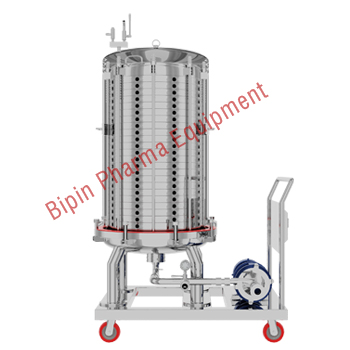
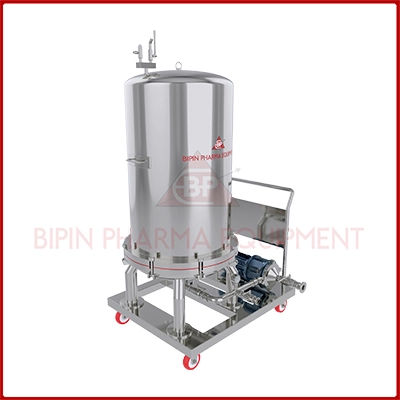
  • The Sparkler Filter Press is used as the primary bulk clarification filter — it efficiently handles large volumes of viscous syrups, can be used with Diatomaceous Earth precoat for turbid liquids, and removes fine particles and activated carbon residues from decolourisation treatments
  • The Zero Hold Up Filter Press is used as the final polishing filter for high-value formulations — its zero dead volume design ensures maximum product recovery with no residual product loss in the filter housing

Without effective filtration, oral liquid products would fail pharmacopoeial visible particulate tests, microbial count specifications, and clarity requirements — making them unfit for patient use and commercially non-releasable.

2. Filtration in API Synthesis and Chemical Manufacturing

In API synthesis plants, filtration is a mandatory step in isolating the solid API from the reaction mass. After synthesis and crystallisation in the SS Reactor, the product slurry is filtered to separate the solid API from the mother liquor. The Agitated Nutsche Filter Dryer (ANFD) is the gold standard for this application — combining filtration, multi-stage cake washing, and vacuum drying in a single contained vessel to deliver a dry, pure API meeting all ICH and pharmacopoeial specifications.

The Sparkler Filter Press is additionally used in API synthesis plants for polishing the mother liquor before solvent recovery — removing fine solid particles that would otherwise contaminate the recovered solvent and carry impurities into the next synthesis cycle.

3. Filtration in Semi-Solid Manufacturing

In Cream & Lotion Manufacturing, the Sparkler Filter Press is used for clarification and particle removal from the aqueous phase before emulsification. For clear gels and low-viscosity lotions, post-manufacture filtration removes any undissolved particles or gel lumps to ensure a smooth, uniform product texture and compliance with pharmacopoeial particulate standards.

4. Filtration in Sterile Manufacturing

Sterile pharmaceutical products — injectables, ophthalmic drops, intravenous infusions — require the most stringent filtration of all: sterilising-grade membrane filtration using 0.2 µm (or 0.22 µm) validated membrane filters. This removes all viable microorganisms from the product, rendering it sterile. The Sterile Manufacturing Vessel system integrates membrane filtration as a mandatory final step before filling into sterile containers.

Upstream of the sterilising filter, bulk filtration removes particulates that could blind the final 0.2 µm membrane — extending its service life and ensuring sterile filter integrity throughout the filling campaign.

Types of Filtration Used in Pharmaceutical Manufacturing

Filtration TypeMechanismTypical Pore SizePrimary Application
Surface (cake) filtrationParticles retained on filter media surface; cake builds up over time1–100 µmBulk liquid clarification; API slurry filtration
Depth filtrationParticles trapped within thickness of filter media by adsorption and mechanical entrapment0.1–10 µmPre-filtration of process liquids; bioburden reduction
Membrane filtrationAbsolute pore size retention; particles larger than pore size 100% retained0.1–0.45 µmBioburden reduction; sterilising filtration
Sterilising filtrationAbsolute 0.2 µm membrane; removes all viable microorganisms (validated per ASTM F838)0.2 µmSterile injectable, ophthalmic manufacturing
Pressure filtrationPressure applied above filter media drives filtrate through; suitable for viscous liquidsProduct-specificSyrup clarification; API solid isolation (Sparkler, ANFD)
Vacuum filtrationVacuum applied below filter media draws filtrate through; suitable for easily filterable slurriesProduct-specificAPI isolation in ANFD; Nutsche filtration

Selecting the Right Filtration Equipment for Each Application

Manufacturing SegmentFiltration RequirementRecommended Equipment
Syrup / oral liquid manufacturingBulk clarification of viscous syrups; DE precoat for turbid liquidsSparkler Filter Press
High-value oral liquid formulationsMaximum product recovery; zero product loss in filterZero Hold Up Filter Press
API solid isolation after synthesisFiltration + cake washing + vacuum drying in one vesselANFD (Nutsche Filter Dryer)
API solution polishing after reactionRemove fine particles from API dissolved in solventSparkler Filter Press
Sterile manufacturing (injectables)Sterilising-grade filtration; 0.2 µm absolute membraneSterilising membrane filter + Sterile Manufacturing Vessel
Herbal extract / botanical clarificationRemove plant cell debris; activated carbon removalSparkler Filter Press
Highly potent API (HPAPI) filtrationComplete containment; cake washing; vacuum dryingANFD (Nutsche Filter Dryer)
Semi-solid aqueous phase clarificationRemove undissolved particles from water phaseSparkler Filter Press

Consequences of Filtration Failure in Pharmaceutical Manufacturing

Filtration failures in pharmaceutical manufacturing carry serious consequences across quality, regulatory, patient safety, and commercial dimensions:

Product Quality Failures

  • Visible particulate contamination in filled oral liquid products — automatic batch rejection
  • API purity failures due to mother liquor carry-over from inadequate solid-liquid separation
  • Residual solvent exceedance in API due to poor cake washing efficiency
  • API polymorphic form conversion due to uncontrolled temperature during open filtration
  • Assay failures due to product loss through inadequate filter media integrity

Microbiological and Sterility Failures

  • Total Aerobic Microbial Count (TAMC) exceedance in oral liquids — batch rejection, product recall risk
  • Sterility failure in injectable or ophthalmic products due to membrane filter integrity failure — patient mortality risk
  • Biofilm formation in filtration equipment due to inadequate CIP cleaning between batches
  • Endotoxin contamination in parenteral products from gram-negative bacterial cell wall fragments passing through filter

Regulatory and Compliance Failures

  • FDA 483 observations and Warning Letters for inadequate filter integrity testing procedures
  • EU GMP non-conformance for failure to validate sterilising filtration processes
  • ICH Q3C residual solvent exceedances in API due to inadequate cake washing validation
  • Batch rejection and destruction costs from non-conforming filtration results
  • Market withdrawal and product recall costs — one recall can cost millions of dollars

What Makes Filtration Equipment GMP-Compliant?

GMP Requirements for Pharmaceutical Filtration Equipment

  • All product-contact surfaces must be SS316L with Ra ≤ 0.8 µm (or Ra ≤ 0.4 µm for sterile and oral liquid applications)
  • Filter housing must have no dead legs, no horizontal surfaces, and complete self-drainage by gravity
  • Filter media compatibility must be validated — extraction testing and material compatibility testing required
  • Filter integrity testing (bubble point or diffuse flow) must be performed before and after each critical filtration batch
  • CIP (Clean-in-Place) spray systems must deliver validated cleaning fluid coverage to all internal surfaces
  • Cleaning validation with TOC or swab sampling required to demonstrate product carryover below acceptable limits
  • All pressure-containing components must be pressure rated and certified per ASME, PED, or equivalent standards
  • Instruments (pressure gauges, flow meters) must be calibrated on a validated schedule
  • ATEX-rated designs required for all filtration equipment in flammable solvent environments
  • IQ, OQ, and PQ validation documentation required; batch records must document all filtration parameters

Regulatory Requirements for Pharmaceutical Filtration

Regulation / GuidelineFiltration Requirements
US FDA 21 CFR Part 211Equipment must be designed to prevent contamination; filters must not add extractables to product; records must document filter use and integrity testing
EU GMP Annex 1 (Sterile Manufacturing)Sterilising filtration must use 0.2 µm validated filters; filter integrity testing before and after use; redundant filters recommended for aseptic processing
WHO GMP TRS 986All critical filtration steps must be validated; filter media must be compatible with product; microbial reduction filters must be integrity tested
Schedule M (India)Filtration equipment must be constructed in corrosion-resistant material; cleaning procedures for all equipment including filters must be validated
ICH Q3C (Residual Solvents)API cake washing filtration must achieve residual solvent levels below class-specific limits; validated wash procedures required
ICH Q7 (GMP for Active Pharmaceutical Ingredients)Filtration is explicitly addressed as a critical operation; integrity testing of sterilising filters mandatory; all parameters must be documented in batch records

Validating Pharmaceutical Filtration Processes

All critical filtration operations in GMP pharmaceutical manufacturing must be validated to demonstrate that the filtration process consistently delivers the required product quality. Key validation elements include:

Filter Media Compatibility Testing

The filter media (paper, cloth, membrane) must be tested for chemical compatibility with the product and solvent, absence of extractables that could contaminate the product, and structural integrity under process temperature and pressure conditions.

Filter Integrity Testing

For sterilising filters, integrity testing by Bubble Point Test or Diffuse Flow Test must be performed before and after each filtration batch. For non-sterilising applications, integrity testing is a GMP best practice. All integrity test results must be documented in the batch record.

Process Validation (Filtration Efficiency)

Filtration process validation must demonstrate that the selected filter type and process conditions (pressure, flow rate, temperature, batch volume) consistently achieve the target filtration endpoint — whether that is a specified NTU clarity, a maximum particle count, a microbial count limit, or a residual solvent level in the API cake.

Cleaning Validation

All filter housings and associated equipment must have validated cleaning procedures. Cleaning validation uses TOC (Total Organic Carbon) analysis or swab sampling to confirm that product residues from the previous batch are reduced to below the Acceptable Carry-Over (ACO) limit before the next product campaign.

Frequently Asked Questions (FAQ)

Why is filtration required in every pharmaceutical product type?
Every pharmaceutical product — whether a tablet granule, a syrup, an injectable, or an API — requires filtration at some stage of its manufacturing. For oral liquids, filtration ensures particulate-free, clear products. For APIs, filtration separates the solid product from the reaction solvent. For sterile injectables, filtration provides the sterilisation step that makes the product safe for parenteral administration. Filtration is the only unit operation that physically removes particles, microorganisms, and impurities from pharmaceutical products — making it irreplaceable in every manufacturing context.
What happens if filter integrity testing fails?
If filter integrity testing fails after a critical filtration batch (particularly for sterilising-grade filters in injectable manufacturing), the entire batch must be placed on hold and cannot be released for commercial use until the root cause is determined and a disposition decision is made. For sterilising filtration failures, the batch is typically quarantined and ultimately destroyed, as the sterility of the product cannot be assured. The failure must be investigated, documented, and corrective actions implemented before the next batch proceeds. This is one of the most serious GMP events in sterile pharmaceutical manufacturing.
Which filter press is best for pharmaceutical syrup clarification?
For bulk pharmaceutical syrup clarification, the Sparkler Filter Press is the most widely used choice — it handles viscous syrups efficiently, supports Diatomaceous Earth precoat for deep bed filtration of turbid liquids, and is available in a range of filter areas for different batch volumes. For high-value formulations where maximum product recovery is critical, the Zero Hold Up Filter Press is preferred as its zero dead volume design ensures no product is left behind in the filter housing after filtration.
How does the ANFD help meet ICH Q3C residual solvent requirements?
The ANFD helps meet ICH Q3C residual solvent limits through two mechanisms: cake washing removes the bulk of the organic solvent from the API filter cake by displacement or reslurry wash cycles, and vacuum drying at controlled low temperature (assisted by jacket heating) removes residual solvent vapours under sub-atmospheric pressure. The condenser connected to the vacuum system condenses these vapours for recovery. Validated wash procedures with defined solvent volumes, contact times, and drying parameters are established during process validation to ensure consistent compliance with ICH Q3C limits batch to batch.
What is the difference between bioburden reduction filtration and sterilising filtration?
Bioburden reduction filtration uses depth filters or membrane filters with pore sizes of 0.45 µm to 1 µm to reduce the microbial count in a liquid — but does not guarantee complete removal of all microorganisms. It is used in non-sterile oral liquid manufacturing to meet pharmacopoeial microbial count limits (TAMC ≤ 100 CFU/mL for non-sterile oral products). Sterilising filtration uses an absolute 0.2 µm membrane filter validated per ASTM F838 to completely remove all viable microorganisms from a liquid — producing a sterile filtrate suitable for filling into sterile containers for parenteral, ophthalmic, or inhalation use. Sterilising filtration must be followed by a pre-use integrity test and a post-use integrity test to confirm filter performance for each batch.

Conclusion

Filtration is a multi-dimensional, non-substitutable critical process step that underpins the quality, safety, purity, and regulatory compliance of pharmaceutical products across every dosage form and manufacturing segment. From clarifying oral liquid syrups to isolating potent APIs and sterilising injectable formulations, filtration equipment selection, validation, and operation are among the highest-priority GMP activities in any pharmaceutical manufacturing facility.

Our complete pharmaceutical filtration equipment range — Zero Hold Up Filter Press, Sparkler Filter Press, and Agitated Nutsche Filter Dryer (ANFD) — is manufactured to GMP standards and is available for pharmaceutical, API, chemical, and nutraceutical manufacturers across India and internationally. All equipment is supported with full validation documentation, material certificates, and technical support.

Enquire About Our Pharmaceutical Filtration Equipment

Speak with our technical team for expert guidance on filtration equipment selection, specifications, and pricing.

Send Enquiry Contact Us

Related Article Pages